
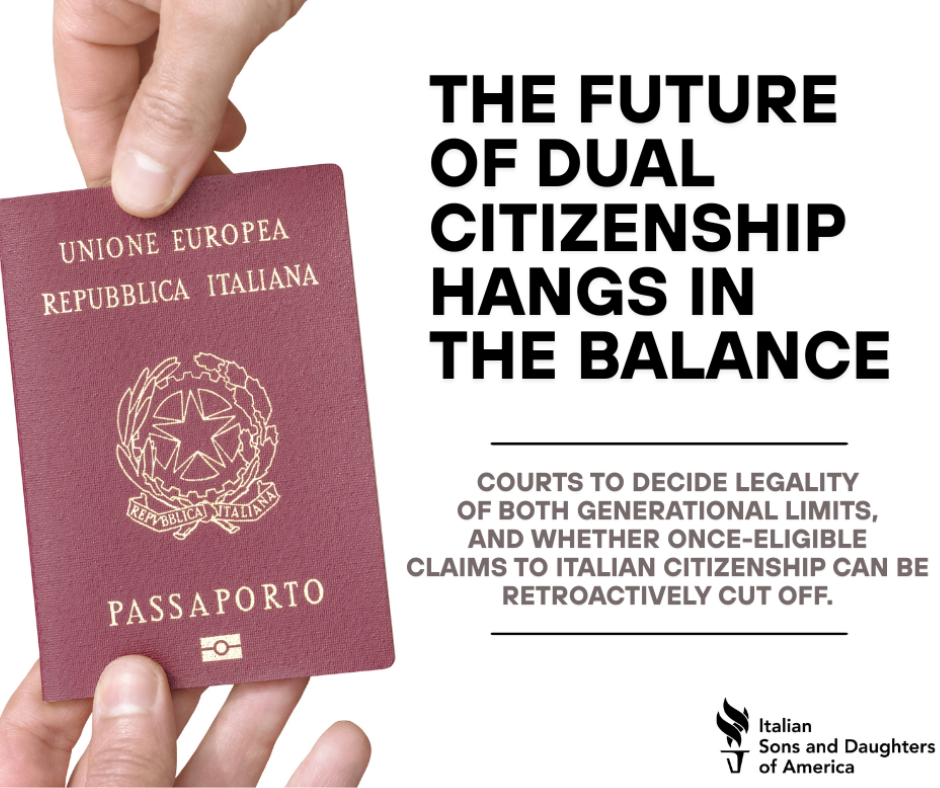
Italy’s shifting approach to dual citizenship is entering a critical moment, with courts set to decide not just future eligibility, but whether previously eligible claims can be undone.
For generations, Italian citizenship by descent (“jure sanguinis” or “right of blood”) was widely understood as a birthright, extending across multiple generations of the diaspora and dating back to Italy’s formation in 1861. For millions of Italian Americans, that principle formed the basis of a deeply personal connection to their ancestral homeland.
This article first appeared in the May 2026 edition of La Nostra Voce, ISDA’s monthly newspaper that chronicles Italian and Italian American news, history, culture and recipes. Subscribe today!
However, the overhaul of this longstanding legal principle is the result of a series of developments that have unfolded over the past two years.
In late 2024, Italy’s Ministry of the Interior introduced a controversial administrative interpretation often referred to as the “minor issue.” Under this view, if the parent of an Italian child born abroad naturalized while the child was a minor, with them becoming, for example, U.S. citizens, then that act would sever the line of descent. The sudden implementation of the issue cut off those whose applications for Italian citizenship were already in progress. The court is now weighing the legality of the introduction of the minor issue through a handful of cases, two of which include Italian American families, according to Newsweek.
A second, more sweeping change followed on March 28, 2025, when Italy enacted reforms to citizenship law commonly known as the Tajani Decree, named after Italian Deputy Prime Minister Antonio Tajani. The measure narrowed eligibility by limiting recognition to those with an Italian parent or grandparent, while cutting off many claims through more distant ancestors that had long been accepted.
Taken together, these developments marked a significant departure from a system that had historically treated citizenship as something inherited, rather than constrained by generational limits or shifting legislative policies.
Now, courts are weighing not only whether these new limits are lawful, but whether they can be applied to individuals whose claims were previously considered valid, including citizenship applications that were already in process, according to the Associated Press.
In the coming months, Italy’s highest court for civil matters, the Corte Suprema di Cassazione (Italy’s Supreme Court), will hear challenges over the minor issue. These applicants will argue that citizenship by descent is not something granted upon application, but something possessed at birth and merely recognized through a legal process. From that perspective, they contend, the state cannot strip individuals of a status they previously held, and that those affected should only include people born after the new restrictions took effect last year.
The government, by contrast, maintains that it has the authority to define and limit the recognition of citizenship claims, particularly in response to administrative strain and evolving national priorities.
On June 9, the Italian Constitutional Court is scheduled to hear a significant case addressing the broader validity of the Tajani Decree and its introduction of generational limits on jure sanguinis citizenship.
If the courts determine that the new restrictions cannot be applied retroactively, the decision could preserve eligibility not only for pending applicants, but for hundreds of thousands, if not millions of people across the Italian diaspora who would have qualified under prior interpretations (even if they had not yet begun the citizenship application process).
Conversely, if the court sides with the government’s interpretation, the new limits will likely stand as a firm boundary, closing the door on dual citizenship for many Italian Americans.
More Than a Legal Question
“For Italian Americans, the issue extends beyond legal technicalities. Applicants often spend years assembling documentation, tracing lineage through generations and navigating a complex bureaucratic process. For many, recognition of citizenship represents not only a legal status, but a reaffirmation of identity: a tangible link to family history, culture and tradition,” said ISDA National President Basil M. Russo, who is working with U.S. Congressmen Tom Suozzi (D-NY) and Mike Rulli (R-OH), from the Italian American Congressional Delegation, and meeting with leaders of the Italian government, to petition for a rollback of the restrictions.
Either way, the outcome will carry significant consequences, not only for those currently seeking recognition, but for how Italian citizenship itself is understood in the 21st century.
For the Italian American community, the moment is pivotal.
What has long been viewed as an inheritance, passed from one generation to the next, now stands at the crossroads of law and policy; its future to be decided in the courts over the next several months, or perhaps even sooner.
In 1930, immigrant families banded together to create the Italian Sons and Daughters of America (ISDA), now one of the most prominent and financially successful Italian American organizations in the nation. In the last decade, we built a 730,000-strong social media community, grew our not-for-profit fraternal association, ISDA Financial Life, to nearly a half billion dollars in member assets, co-founded the Russo Brothers Italian American Filmmaker Forum (RBIAFF), and launched the fastest-growing Italian American publication (La Nostra Voce).
