
By Marco Nivellini
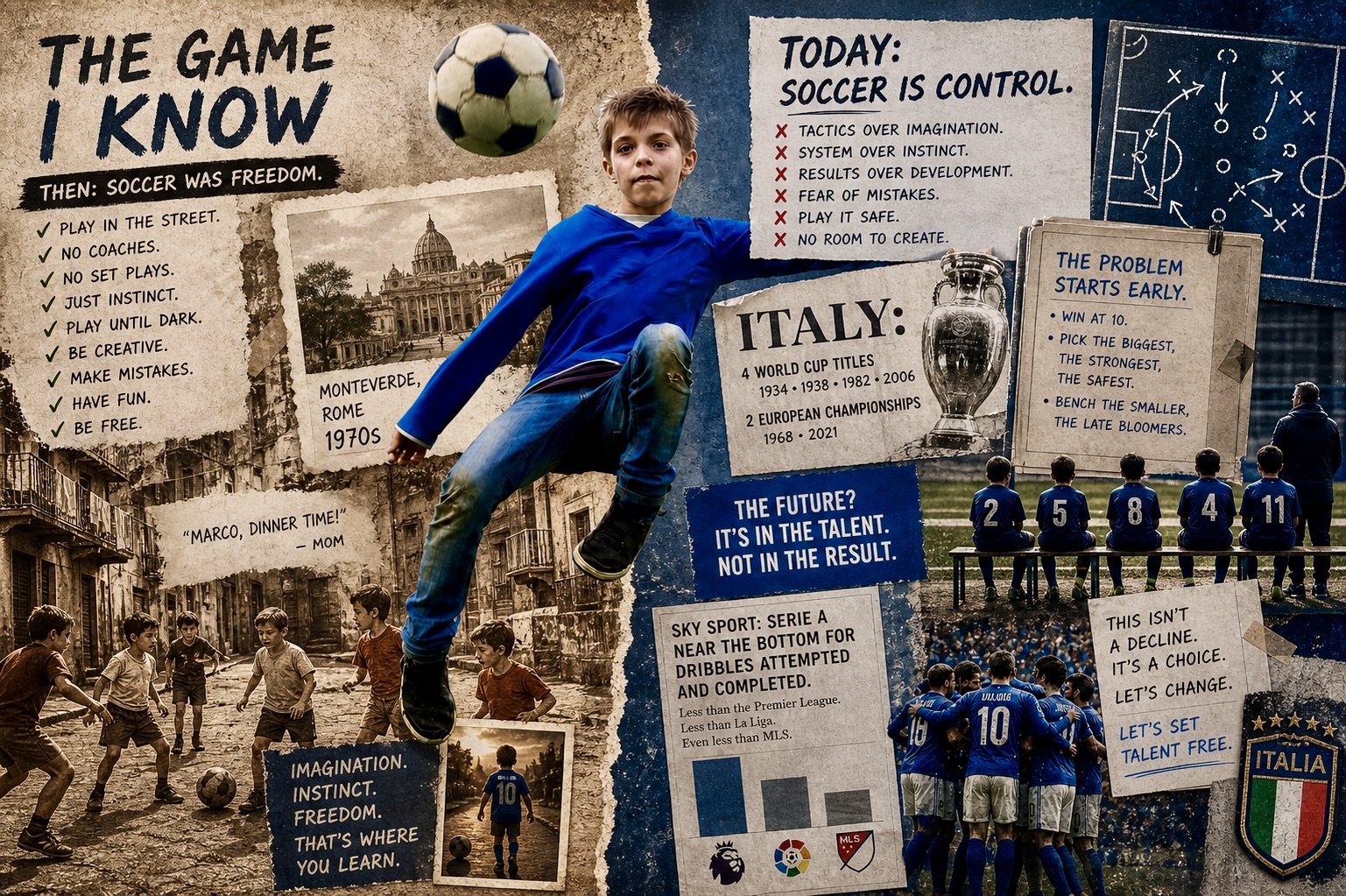
I’m 54 and I still play soccer once or twice a week without fail. Not because I think I’m a star, but because that ball (made of hard leather back then) has never left my side since I was a young kid in Rome, in Monteverde, when we used to play in the street until dark.
No coaches, no set plays, no one yelling at you what to do every second, except for my mom. At 8 o’clock sharp, from the balcony of my apartment, she would scream, “Marco, stop playing, it’s dinner time!” Great times. That was free, instinctive, sometimes chaotic soccer, but it built character like nothing else. That’s where you truly learned: you’d try a dribble 10 times and fail eight, but those two successful ones made you feel alive.
This article first appeared in the May 2026 edition of La Nostra Voce, ISDA’s monthly newspaper that chronicles Italian and Italian American news, history, culture and recipes. Subscribe today!
But it wasn’t just that. You’d try a chip shot for no reason, a backheel just to make your friends laugh and blow them away, or a no-look pass like Francesco Totti: those slightly crazy moves that didn’t always work out. It was soccer made of imagination, instinct, and freedom.
Today I look at Italian soccer, our Serie A, and I struggle to recognize that spirit. And you don’t need to be a player, a coach, or an analyst to notice it. I’m certainly no expert. I don’t have coaching licenses, and I haven’t written books on tactics. I’m simply a passionate fan, a lifelong supporter of my team, AS Roma, someone, like many, who lives and breathes soccer. And maybe it’s precisely from this genuine and simple perspective that the issues stand out even more clearly.
A while ago, I saw a report on Sky Sport that got me thinking. Among all the major leagues in the world, including the European ones, Serie A is near the bottom for both attempted and successful dribbles. Less than the Premier League, less than La Liga, and even less than Major League Soccer.
And so, you ask yourself: how is this even possible?
Because dribbling isn’t just a statistic. It is an important indicator, but it’s also a powerful language. It’s the courage to try something. But along with dribbling, other things are disappearing too: the chip shot when no one expects it, the backheel that opens up the game, the Totti-style no-look pass made up on the spot, the kind of play that makes you jump off the couch. In Spain, you still see players constantly risking the one-on-one. In the Premier League, it’s normal to see wingers take on their man 10 times a game. Even in Major League Soccer, which used to be considered inferior and suffers from many of the same issues as Italian soccer, today you find a bit more rhythm, courage, and individual initiative. In Italy, too often, you see the opposite: control it, lay it off, drop it back. Safety first. Long diagonal balls from one side to the other. But very little creativity.
And this doesn’t start in Serie A. It starts much earlier. It starts on the street and on the youth soccer fields.
Today in Italy, kids play to win at 10 years old. At 11. At 12. And to win, coaches pick the biggest, most developed, and most physically ready kids. The safe and large players. The smaller kid, who might be more technically gifted, gets left behind. Not because he isn’t good, but because at that moment he is less dominant. This is where a globally known phenomenon comes into play, the “relative age effect”: those born in the first months of the year have an advantage because they are bigger than their peers born at the end of the year. And coaches, often without even realizing it, pick them. They play them, help them grow, and let them gain experience. The others, often smaller or younger, stay on the bench. All that matters is winning the local or neighborhood tournament. That way, the parents and the coaches are happy.
So it makes you wonder: if guys like Francesco Totti or Alessandro Del Piero, who were both born toward the end of the year, were growing up in this system today, would they have had the same chances? Or would they have been considered too small, too fragile, and pushed aside? It’s an uncomfortable question, but a necessary one.
On top of all this, there is another element that, in my opinion, is doing massive damage: the obsession with defense and tactics. In Italy, we’ve always been good at defending and tactics; it’s part of our soccer identity. But today, we’ve gone overboard. Tactics have become an obsession that starts as early as 7 or 8 years old. Children who are supposed to be having fun are filled with set plays, positioning, and chores. “Play simple,” “don’t take risks,” “don’t lose the ball.” But also: “no backheels,” “no chip shots,” “no weird moves.” Basically: zero imagination.
This creates a player who is organized and disciplined, but predictable. And when you get to the international level, predictability kills you. Because in the meantime, everyone else has kept nurturing unpredictability too.
Then there’s the system, namely the FIGC (Italian Football Federation). An outdated structure that is still too tied to old ways of thinking. It’s not enough to just change a president or a couple of directors. If you truly want change, you must step in at the key points, with the people who actually make the decisions. It’s not about destroying everything, but about having the courage to profoundly overhaul ideas, methodologies, and priorities.
Another aspect people rarely talk about, but that carries massive weight, is the steady disappearance of Italian players from top teams. Today in Serie A, around 70% of the minutes are played by foreigners, which is among the highest percentages in Europe. In some matches, less than a third of the starters are Italian. This isn’t just a feeling; it’s a fact. And this inevitably shrinks the pool the National Team can draw from.
The reasons are varied. On one hand, there is the global market, which makes it easier and often more cost-effective to buy players from abroad. On the other hand, there’s a system that prefers immediate results over the long term: it’s easier to buy a ready-made player than to wait for an Italian kid and help him grow. And yes, economic interests, commissions, and dynamics between clubs and agents play a role in this mechanism too. But the point isn’t to look for one single scapegoat. The point is that the result is right in front of us: fewer Italians playing at a high level means fewer Italians becoming champions. And in the end, when it is time to step up for the National Team, that is where you pay the price.
Years ago, after Italy was knocked out in the 2010 group stage, Roberto Baggio worked on a massive project to reform Italian youth soccer. A document of a solid 900 pages, full of ideas, concrete proposals, and common sense. The core idea was simple: we need a national plan, a shared vision, that puts talent and player development at the center, not immediate results. That work, however, was largely ignored. Baggio essentially stepped down from his role as an advisor. And that says a lot. The paradox is that talent has never been lacking in Italy. You just must look at our history. We’ve had Andrea Pirlo, Roberto Baggio himself, Francesco Totti, Alessandro Del Piero. Players capable of inventing soccer out of nowhere. An impossible through ball, a backheel that puts a teammate clean through on goal, a no-look assist, or a chip shot that humbles the goalkeeper. Today, you see these plays less and less. Not because they have disappeared, but because fewer and fewer players are encouraged to try them.
And sure enough, the results are there for everyone to see. The struggles of the national team, the disappointments, the eliminations that hurt so much. These aren’t accidents. They are consequences.
But heed my word: it’s not all doom and gloom! Far from it. And this is where I want to talk to those who, like me, have Italian roots but might live in America and to anyone who feels part of this culture even from a distance. Because it is easy to forget where we come from when times get tough.
We come from an incredible history. Italy has won four World Cups: in 1934, 1938, 1982, and 2006. We have won two European Championships, in 1968 and 2021. We are one of the most successful and respected national teams in the history of soccer. That isn’t just a minor detail; it is our identity. It is pure italian pride.
And that Euro 2021 title wasn’t a miracle. It was the result of a group that, for a moment, rediscovered its enthusiasm, quality, and courage. They played without fear. They took risks. At times, they even played with simple imagination.
This means that we can make a comeback. It’s not a genetic problem, and it’s not that “we don’t have it anymore.” It is simply a matter of choices.
We need to bring soccer back to its essence, especially for the youth. Let the kids be free to make mistakes, to try things, and to have fun. Allow them not just to take on defenders, but to attempt a chip shot, a backheel, an imaginative no-look pass, or a move born entirely out of instinct. We need to train coaches who understand this. We need a federation that has the courage to truly change and get more Italians playing in Serie A.
I still play in my friendly matches. And every now and then, I still try to do something different: a dribble, a chip shot, or an imaginative pass that maybe doesn’t work out as well as it used to. But when it does happen, for a split second, I am that young kid from Monteverde again whose mom was yelling from the balcony. And I think that soccer, deep down, should still be exactly that. If we can manage to remember this, and if we have the humility and intelligence to change a few things, then maybe this isn’t an inevitable decline, but just a phase.
Because talent in Italy has never run out. It just needs to be set free to express itself. And maybe, the next time a young kid tries to take a man on or make a risky pass, instead of yelling “stop that and pass the ball!”, the coach from the bench will have the audacity to scream: “Awesome move! Try it again!”
Italian translation:
Ho 54 anni e continuo imperterrito a giocare a calcio una o due volte a settimana. Non perché pensi di essere un campione, ma perché quel pallone (all’epoca di cuoio duro) non mi ha mai lasciato da quando ero ragazzino a Roma, a Monteverde, quando si giocava per strada fino a sera. Senza allenatori, senza schemi, senza qualcuno che ti urlasse cosa fare ogni secondo, tranne mia mamma. Alle 8 in punto, dal balcone del mio appartamento, urlava “Marco, basta giocare, e’ ora di cena !” Bei tempi. Quello era un calcio libero, istintivo, a volte caotico, ma tremendamente formativo. È lì che imparavi davvero: provavi il dribbling dieci volte, ne riuscivano due, ma quelle due ti facevano sentire vivo. Ma non era solo quello. Provavi il pallonetto senza motivo, il colpo di tacco per far ridere e stupire gli amici, il passaggio no-look alla Francesco Totti, quelle giocate un po’ folli che magari non sempre riuscivano. Era un calcio fatto di fantasia, di istinto, di libertà.
Oggi guardo il calcio italiano, la nostra Serie A, e faccio fatica a riconoscere quello spirito. E non serve essere un calciatore, un allenatore o uno studioso per accorgersene. Io non sono certo un esperto. Non ho patentini, non ho scritto libri di tattica. Sono semplicemente un appassionato, tifoso romanista della mia squadra AS Roma da sempre, uno che il calcio lo vive. E forse proprio da questa posizione genuina e semplice i problemi si vedono ancora più chiaramente.
Qualche tempo fa ho visto un servizio su Sky Sport che mi ha fatto riflettere. Tra tutti i principali campionati del mondo, inclusi quelli europei, la Serie A è tra quelli con meno dribbling tentati e riusciti. Meno della Premier League, meno della La Liga, meno perfino della Major League Soccer. E allora ti chiedi: com’è possibile?
Perché il dribbling non è solo una statistica. È un indice importante ma anche un linguaggio. È il coraggio di provare qualcosa. Ma insieme al dribbling spariscono anche altre cose: il pallonetto quando nessuno se lo aspetta, il colpo di tacco che apre il gioco, il passaggio alla Totti inventato senza guardare, quello che ti fa alzare dal divano. In Spagna vedi ancora giocatori che rischiano costantemente l’uno contro uno. In Premier League è normale vedere esterni che puntano l’uomo dieci volte a partita. Anche nella Major League Soccer, che una volta veniva considerata inferiore, e che soffre di problematiche simili a quelle italiane, oggi trovi un po’ più di ritmo, coraggio, iniziativa individuale. In Italia, troppo spesso, vedi il contrario: controllo, appoggio, scarico. Sicurezza. Passaggi lunghi da una sponda all’altra. Ma poca invenzione.
E questo non nasce in Serie A. Nasce molto prima. Nasce per strada e nei campi dei ragazzini.
Oggi in Italia si gioca per vincere a dieci anni. A undici. A dodici. E per vincere si scelgono i ragazzi più grandi, più sviluppati, più pronti fisicamente. I cosiddetti “cristoni”. Il ragazzino più piccolo, magari tecnicamente più dotato, viene lasciato indietro. Non perché non sia bravo, ma perché in quel momento è meno dominante. Qui entra in gioco un fenomeno conosciuto in tutto il mondo, il “relative age effect”: chi nasce nei primi mesi dell’anno è avvantaggiato, perché è più grande rispetto ai coetanei nati a fine anno. E gli allenatori, spesso senza rendersene conto, scelgono lui. Lo fanno giocare, lo fanno crescere e acquista esperienza. Gli altri, spesso più piccoli o più giovani, restano in panchina. Conta solo vincere il torneo provinciale o di quartiere. Cosi sono contenti i genitori e gli allenatori.
E allora viene da chiedersi: se oggigiorno crescessero in questo sistema ragazzi come Francesco Totti o Alessandro Del Piero, entrambi nati verso la fine dell’anno, avrebbero avuto le stesse possibilità? O sarebbero stati considerati troppo piccoli, troppo fragili, e quindi messi da parte? È una domanda scomoda, ma necessaria.
A tutto questo si aggiunge un altro elemento che, secondo me, sta facendo danni enormi: l’ossessione per la tattica. In Italia siamo sempre stati bravi tatticamente, è parte della nostra identità calcistica. Ma oggi si è andati oltre. La tattica è diventata un’ossessione che parte già dai sette, otto anni. Bambini che dovrebbero divertirsi vengono riempiti di schemi, posizioni, compiti. “Gioca semplice”, “non rischiare”, “non perdere palla”. Ma anche: “niente colpi di tacco”, “niente pallonetti”, “niente giocate strane”. In pratica: niente fantasia.
Così si forma un giocatore ordinato, disciplinato, ma prevedibile. E quando arrivi a livello internazionale, la prevedibilità ti uccide. Perché gli altri, nel frattempo, hanno continuato a coltivare anche l’imprevedibilità.
Poi c’è il sistema, cioè la FIGC Federazione Italiana Gioco Calcio. Una struttura anacronistica e ancora troppo legata a logiche vecchie. Non basta cambiare un presidente o due dirigenti. Se vuoi davvero cambiare, devi intervenire nei punti chiave, nelle persone che prendono decisioni. Non si tratta di distruggere tutto, ma di avere il coraggio di rinnovare profondamente le idee, le metodologie, le priorità. Un altro aspetto di cui si parla poco, ma che pesa tantissimo, è la progressiva scomparsa dei giocatori italiani dalle squadre di vertice. Oggi nella Serie A circa il 70% dei minuti viene giocato da stranieri, una percentuale tra le più alte d’Europa. In alcune partite, meno di un terzo dei titolari è italiano. Non è solo una sensazione: è un dato di fatto.
E questo inevitabilmente riduce il bacino da cui la Nazionale può pescare. Le ragioni sono diverse. Da una parte c’è il mercato globale, che rende più facile e spesso più conveniente comprare giocatori dall’estero. Dall’altra c’è un sistema che preferisce l’immediato al lungo termine: è più semplice prendere un giocatore già pronto che aspettare un ragazzo italiano e farlo crescere. E sì, in questo meccanismo entrano anche interessi economici, commissioni, dinamiche tra club e procuratori. Ma il punto non è cercare un colpevole unico. Il punto è che il risultato finale è sotto gli occhi di tutti: meno italiani giocano ad alto livello, meno italiani diventano campioni. E alla fine, quando arriva il momento della Nazionale, il conto lo paghi.
Anni fa, dopo che l’Italia e’ stata eliminata nel 2010 nella fase a gironi, Roberto Baggio ha lavorato a un progetto enorme per riformare il calcio giovanile italiano. Un documento di ben 900 pagine pieno di idee, di proposte concrete, di buon senso. Il punto centrale era semplice: serve un piano nazionale, una visione condivisa, che metta al centro il talento e la crescita dei giocatori, non il risultato immediato. Quel lavoro, però, è rimasto in gran parte ignorato. Baggio si e’ praticamente dimesso dal ruolo di consigliere. E questo dice molto.
Il paradosso è che il talento in Italia non è mai mancato. Basta guardare la nostra storia. Abbiamo avuto Andrea Pirlo, lo stesso Roberto Baggio, Francesco Totti, Alessandro Del Piero. Giocatori capaci di inventare calcio dal nulla. Un passaggio filtrante impossibile, un colpo di tacco che manda in porta un compagno, un assist senza guardare, un pallonetto che umilia il portiere. Oggi queste giocate si vedono sempre meno. Non perché siano scomparse, ma perché sempre meno giocatori vengono incoraggiati a provarle.
E infatti i risultati si vedono. Le difficoltà della nazionale, le delusioni, le eliminazioni che fanno male. Non sono incidenti. Sono conseguenze.
Ma attenzione: non è tutto da buttare. Anzi. Ed è qui che voglio parlare a chi, come me, ha radici italiane ma vive magari in America, a chi si sente parte di questa cultura anche a distanza. Perché è facile dimenticare, nei momenti difficili, da dove veniamo.
Noi veniamo da una storia pazzesca. L’Italia ha vinto quattro Coppe del Mondo, nel 1934, 1938, 1982 e 2006. Ha vinto due Europei, nel 1968 e nel 2021. Siamo una delle nazionali più vincenti e rispettate della storia del calcio. Non è un dettaglio, è identità. È orgoglio nazionale.
E quell’Europeo del 2021 non è stato un miracolo. È stato il risultato di un gruppo che, per un momento, ha ritrovato entusiasmo, qualità, coraggio. Ha giocato senza paura. Ha rischiato. Ha anche, a tratti, inventato.
Questo vuol dire che si può tornare. Non è un problema genetico, non è che “non siamo più capaci”. È una questione di scelte.
Serve riportare il calcio alla sua essenza, soprattutto nei giovani. Lasciare i bambini liberi di sbagliare, di provare, di divertirsi. Permettere loro non solo di saltare l’uomo, ma di tentare un pallonetto, un colpo di tacco, un passaggio di fantasia senza guardare, una giocata che nasce dall’istinto. Serve formare allenatori che capiscano questo. Serve una federazione che abbia il coraggio di cambiare davvero e far giocare piu’ italiani in serie A.
Io continuo a giocare le mie partite amichevoli. E ogni tanto provo ancora a fare qualcosa di diverso: un dribbling, un pallonetto, un passaggio di fantasia che magari non mi riesce più come una volta. Ma quando succede, per un attimo torno a essere quel ragazzino di Monteverde sgridato dalla mamma. E penso che il calcio, in fondo, dovrebbe essere ancora quello. Se riusciremo a ricordarcelo, se avremo l’umiltà e l’intelligenza di cambiare alcune cose, allora forse questo non è un declino inevitabile, ma solo una fase.
Perché il talento in Italia non è mai finito. Deve solo essere lasciato libero di esprimersi. E magari, la prossima volta che un ragazzino prova a saltare l’uomo o fare un passaggio azzardato… invece di urlargli “smettila o passa!”, l’allenatore dalla panchina invece avrà il coraggio di gridare: ”Bravissimo. Riprovaci!”
