
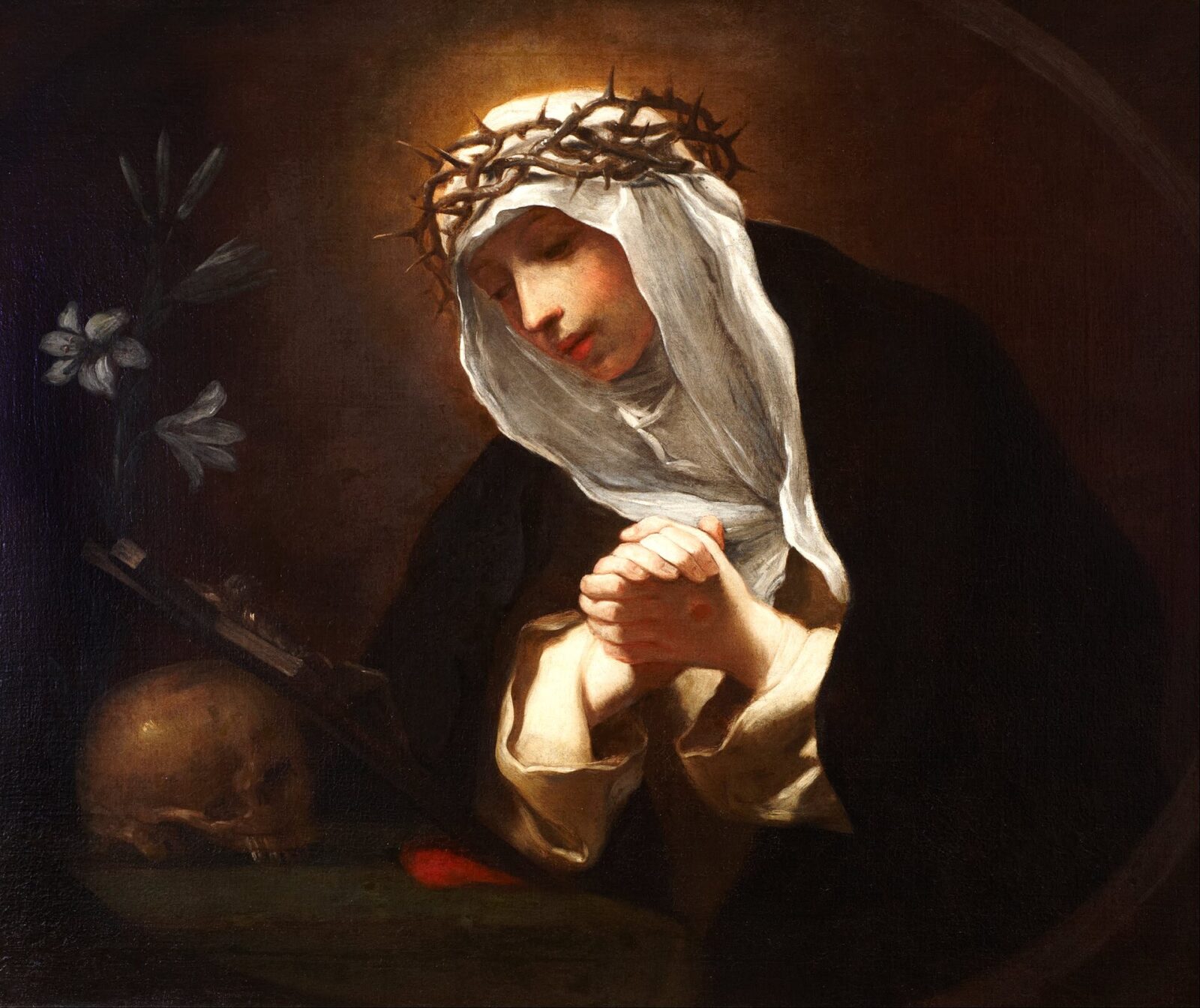
St. Catherine was born in 1347 in Siena; she was the daughter of a cloth dyer and one of many children in a working household.
According to early accounts, she demonstrated a strong religious inclination from a young age and she was even said to have made a private vow of dedication to God around the age of seven. As a teenager, she resisted family expectations of marriage, at one point cutting her hair as an act of protest.
Rather than entering a convent, Catherine joined the Mantellate, a lay branch of the Dominican order, and lived primarily at home under a disciplined routine of prayer and service.
By her 20s, her role had expanded beyond private devotion. She became active in caring for the sick and poor, particularly in local hospitals in Siena, where plague victims suffered in conditions that were beyond substandard.
Her reputation for piety and commitment drew attention, and she became known locally as a santa donna, or “holy woman.”
Catherine is perhaps best known for her extensive correspondence. She wrote hundreds of letters to a wide range of figures, including civic leaders, clergy and rulers, addressing political, social and religious issues of the time.
During the period when the papacy was based in Avignon, she urged Pope Gregory XI to return the papal seat to Rome. He did so in 1377, a move to which her advocacy is often linked.
In addition to her letters, she authored The Dialogue, along with various prayers and writings that contributed to her lasting influence in both religious and literary contexts.
Catherine died in Rome in 1380 at the age of 33.
Her recognition grew in the centuries that followed.
She was canonized in 1461, declared a Doctor of the Church in 1970, and is recognized as a patron saint of Italy and, later, of Europe.
Catherine of Siena resonates less as a distant historical figure and more as a reflection of lived tradition.
Her outspoken advocacy was grounded in her home and community, a pattern familiar to generations of Italian Americans, where devotion is practiced daily and often shaped by a matriarchal influence.
She held no formal authority, yet her voice carried weight, reinforcing a cultural respect for influence earned through service and conviction rather than title.
Her Feast Day is celebrated on April 29.
Make a pledge and become a member of Italian Sons and Daughters of America today.
