

The following Q&A appeared in the December 2024 edition of ISDA’s monthly Italian American newspaper, La Nostra Voce. Subscribe today.
Marianna, in 2016, you resurrected the Italian Hall, one of the oldest Italian American landmarks in Los Angeles, and transformed it into the Italian American Museum of L.A. (IAMLA). What inspired you to take on this project, and how did you bring it to life?
Growing up in Los Angeles, it wasn’t clear how I fit into the city as an Italian American nor how I fit into Italian America as a Los Angeles native. California’s Italian Americans were absent from local history just as they were absent from Italian American histories. When I was in college I learned about the Italian Hall, a historic building at the edge of downtown that had been a community gathering place in the early 1900s. An effort was underway to restore the century-old building, which the Italians had stopped using in the 1950s. When I first visited the dilapidated building, the windows were boarded up, there were pigeons flying around, and temporary supports prevented the roof from caving in. I was nonetheless floored. The Italian Hall demonstrated that Italians did indeed have a place in Los Angeles. I said to myself, “This building needs to be a museum, and I want to be the director.”
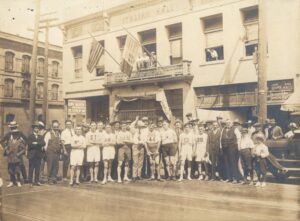
Ha! I had absolutely no idea what I was getting myself into, but that moment inspired what became the focus of my research as well as my vocation. I began working on the museum project in 2005 and have served as director of the IAMLA since 2010. The last two decades have been nonstop, from our capital campaign and construction to creating our permanent exhibition, opening our doors, and all that has taken place since then. The desire to preserve our history served as the impetus, and the generosity, dedication, and vision of many people, in addition to myself, make the IAMLA possible.
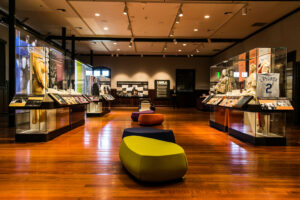
Let’s talk about some of your exhibitions over the years: The Sicilian Cart: History in Movement, Woven Lives: Exploring Women’s Needlework from the Italian Diaspora, A Real Boy: The Many Lives of Pinocchio, and Louis Prima: Rediscovering a Musical Icon. Each one is a tribute to Italian and Italian American artistry and craftsmanship, but they also seem to reveal the intricate connections within the Italian American culture. Can you share more about the stories these exhibitions tell and the impact they create?
The IAMLA features an award-winning permanent exhibition that is accessible both in person and online. Each year, we present original temporary exhibitions and a variety of public programs. We use the exhibits and programs as vehicles to engage the public, encourage visitors to return, and attract new audiences. As we are conceiving and designing exhibitions, I prioritize stories that have yet to be explored by a museum, stories that should be told from an Italian American perspective (such as our recent exhibition about Sicilian American musical icon Louis Prima), and topics that will be interesting and relevant to non-Italian Americans, as they are the majority of our visitors. Everyone knows Pinocchio, but they are often unaware that the tale originated in 1881 in Tuscany, not Disney Studios. Why has Pinocchio been translated in more languages than any other book besides the Bible? That’s what we wanted audiences to consider when they visited the 2022 exhibition, A Real Boy: The Many Lives of Pinocchio. When the IAMLA presented Woven Lives, an exhibit that explored Italian American women’s stories told through needlework, we showcased the experiences and craftsmanship of women who are underrepresented in history, women who never imagined their creations would be exhibited in a museum. Our visitors, regardless of their heritage, saw their mothers, grandmothers, and other relatives in the women’s stories. We are working on bringing this exhibit to New York. In 2017, we partnered with the Musca Museum of Sicily and Dolce & Gabbana to complete the exhibit on Sicilian carts, which were largely unknown to most of our visitors.

The carts are stunning, but when visitors learned that they also told stories — that the carts functioned as “books on wheels,” — they looked at them in an entirely different way. We live in a world dominated by screens, and while you can show your granddaughter a video of a Sicilian cart on your tablet, the day that nonnotakes her to the museum to see the carts in person, that she will never forget. In terms of impact, the IAMLA provides resources to people who often lack access to quality arts and educational experiences. We increase awareness of the many voices that make the American nation in an era when teaching history and the humanities has taken a back seat to STEM (science, technology, engineering and math) to the detriment, in my opinion, of our society.
West Coast Italian American history is often overshadowed by its East Coast counterpart. Few are aware that Italian immigration to what is now California began in the early 1800s, predating the “Great Arrival” to New York City (1880s–1920s). In what ways have Italian Americans influenced the Golden State?
The East Coast is indisputably the Italian American “giant” in terms of population. But, most of the Italians who came to the US in the late 1800s and early 1900s were economic refugees. They went to where there was opportunity, and for that reason you will find Italian American communities in places we often overlook, like Iowa, Nebraska, Colorado, Texas, Louisiana, and Arkansas, each of which has its own fascinating history. And if you speak with the Italian Americans of those places, they consider themselves every bit as “Italian” as Italo New Yorkers and Bostonians.
Italians began settling in Los Angeles in the 1820s — nearly 200 years ago — before there was a California, when the region was still part of Mexico. This early group played a pivotal role in advancing agriculture and viticulture (winemaking) in the region. The history of Italians in Los Angeles is fascinating on many levels. You see some similarities with the East Coast, such as the existence of Italian neighborhoods and churches, chain migration, but you also see differences. For instance, there was less anti-Catholic sentiment directed at Italians in early Los Angeles because the city was founded as a colonial outpost of Catholic Spain. There is no aspect of the Los Angeles region that Italian Americans did not influence in some way. By studying the Italian American experience in Los Angeles, we gain a deeper understanding of the Italian diaspora as well as a more complete understanding of the city’s history. Los Angeles is one of the most photographed cities in the world; it’s also a city that has long promoted myths surrounding its origins.
You’ve just released a new book, The Italian Americans of Los Angeles: A History, which seeks to broaden and reframe the historical narrative of the Italian American experience. What can readers expect as they turn the pages?
The Italian Americans of Los Angeles is a lavishly illustrated, 200-year history of Italian Americans in greater Los Angeles, from the time of the first Italian settler’s arrival to the present. It explores Italian American neighborhoods and traditions; contributions to politics and sports; unique expressions of faith; the way in which Italian Americans have shaped the entertainment industry (and how the industry has shaped perceptions of Italian Americans); the experiences of Italian Americans during the Enemy Alien restrictions of World War II; and much more. It’s the first comprehensive survey of Italian Americans in the City of Angels, and while situated out West, there are lots of connections to other parts of the country, places like New Orleans, New York, Chicago, New Jersey, etc. You’ll discover agriculturalists and outlaws, pioneers and powerbrokers. It’s a very colorful book with many never-before-published images.

Both IAMLA and the Italian American Museum of Cleveland (IAMCLE) are supported by ISDA , and we hear there’s a collaboration in the works. Tell us more about this emerging partnership between IAMLA and IAMCLE, and share your perspective on the opportunities and challenges within the nonprofit landscape?
Exhibitions are both an art and a science, and small museums often struggle with things like exhibitions, content, and programming because they lack staff. The IAMLA produces two original temporary exhibitions each year, and rather than being placed in storage when they come to an end, it’s my hope that more of them get to travel. This way, the IAMLA can help bring quality educational experiences to other communities, and institutions like IAMCLE can expand their impact and offerings while also remaining within budget. In 2025, IAMLA and its partner, the Gia Maione Prima Foundation, will collaborate with IAMCLE to bring the original exhibition, Louis Prima: Rediscovering a Musical Icon, to Cleveland. We are very excited about this. The pandemic was a great teacher, and I think collaborations that enable Italian American and other educational institutions to make the most of their resources will be critical in the coming years.
Studies show that when children understand who they are and where they come from, they’re more likely to succeed, thanks to a strong sense of self. As the holidays approach, what message would you share with Italian American families about the importance of heritage and ancestral histories?
I would say take the time to speak, share stories, look at photographs, talk about the people who came before us. There are so many lessons to be learned from the past, including resilience, interdependence, and determination.
Could you share a holiday memory of cooking with your parents and/or grandparents, and what that experience meant to you?
Unfortunately, my grandparents died before I was born or when I was very young, so I do not have many memories with them. It was my father who encouraged my sense of italianità, who encouraged reverence for our family’s history, and who I cooked and baked alongside. He preserved my grandmother’s handwritten recipes and those of his father, and I’m now the custodian of these heirlooms. Replicating them each year helps me maintain a connection to family members who are no longer with us, something that I have written about in a series of articles for ISDA. It’s also a way that I reinsert ritual in the holiday season increasingly defined by consumerism.
What’s the next exhibition/story that’s coming to IAMLA?
Earlier this month, the IAMLA opened its newest original temporary exhibition, Creative Minds: Italian American Inventors and Innovators, and it has been a huge hit. From the Jacuzzi and the telephone to the nuclear reactor and the Big Mac, Italian American inventors and innovators have impacted our lives in ways great and small. Creative Minds examines the achievements and personal stories of Italian American inventors and vanguards. It features a range of objects, rare documents and images, and spanning technology, science, cuisine, education, and medicine. This exhibition will continue for ten months and will include a variety of programming for all ages. The next exhibition we are working on is about Italian American food and foodways, from the farm to the table, and tracing the evolution of Italian food in America from a cuisine consumed almost exclusively by immigrants in their own homes to one of the nation’s most popular ethnic cuisines.

To purchase copy of The Italian Americans of Los Angeles: A History, click here.