
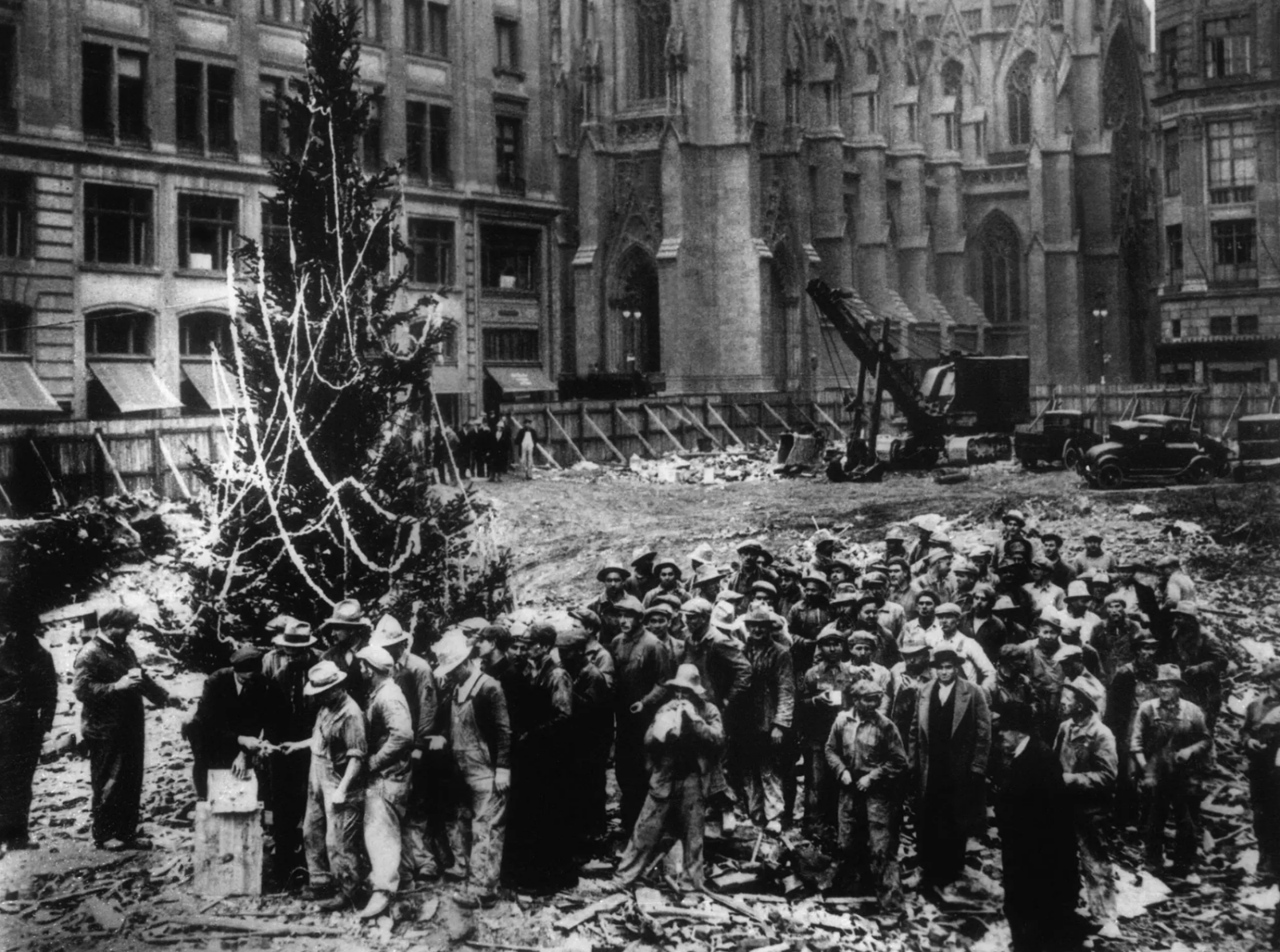
Italian immigrant laborers at Rockefeller Center pooled their money to buy a Christmas tree. The men’s families decorated the 20-foot balsam fir with makeshift garlands. This photo, taken on Dec. 24, 1931, shows the men lined up to receive their wages.
In 1931, with the Great Depression casting a long shadow over the country, a crew of Italian immigrants began excavating the foundation for what would become Rockefeller Center. Grateful to have work when so many were struggling, they decided to bring some holiday cheer to the grinding and risky work site in Midtown Manhattan.
By Christmas Eve, they had pooled their money, purchased a modest 20-foot balsam fir and decorated it with whatever they could find: cranberries, paper garlands, tin cans, even foil wrappers from blasting caps. That simple tree marked the humble beginnings of what we now know as the Rockefeller Center Christmas Tree tradition.
By 1933, the tradition had grown significantly. That year, Rockefeller Center raised its first official Christmas tree — a 50-foot fir wrapped in 700 lights.
Today, the Rockefeller Center Christmas Tree stands as a towering symbol of the holiday season.
Adorned with 50,000 LED lights and topped with a dazzling Swarovski star comprised of 3 million crystals, the Norway Spruce will come to life on December 3, 2025, marking the official start of the Christmas season.
The tradition’s lasting significance lies in its origins: a simple act of gratitude and hope during one of the nation’s darkest times.
What began as a small gesture by hardworking immigrants has become a cherished part of the holiday season, reminding us of the resilience, community and spirit that continue to define this celebration.
