The prestigious Donna Distinta Award, presented by the Italian Sons and Daughters of America (ISDA) and the Conference of Presidents of Major Italian American Organizations (COPOMIAO), celebrates outstanding women of Italian descent to spotlight their contributions, from culture and industry to philanthropy and advocacy.
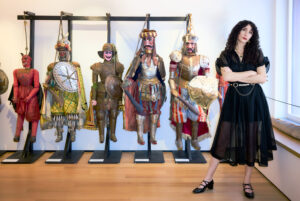
The May 2025 Donna Distinta Award goes to Ms. Marie Palladino. Palladino is the Head of Education at New York City’s Italian American Museum, the first museum in the United States dedicated to Italian American history and culture. She received her Master of Arts in Museum Education from Tufts University in 2017, and Bachelor of Arts in Italian Studies and Art History from the University of Rhode Island in 2010. She has dedicated much of her career to developing educational resources including programs, curriculum, and exhibits on Italian American culture and history.
“The one thing they can never take away from you is your education,” is a piece of advice that Marie always remembers her grandfather reciting to his children and grandchildren. He was from a family of contadini class immigrants from Frosinone but would prioritize academic learning in his household. He set the bar by receiving the first college degree in the Palladino family, not an easy feat for a kid coming out of a Southern Italian immigrant community in those days. He would go on to become an educator himself, inspiring all his children and grandchildren to graduate from college. Each one of them. She credits him, and both her parents (all three K-12 educators) with what her father calls her “educator gene.”
Basil M. Russo, the president of ISDA and COPOMIAO, will present the 2025 Donna Distinta Awards on June 7 in NYC.
Marie was born in Boston, Mass., to an Italian American family hailing from Sicily, Lazio, Emilia Romagna, and Umbria. She often considers the stark contradiction for her grandparents and parents, the first generations in this country after hundreds of years of agricultural living in another. They pushed to make changes with no manual, no example, and much sacrifice in a strange and not always welcoming new corner of the world. Aside from her parents, she was largely raised by her Sicilian grandmother, Stella, who would take her regularly when she was as young as 3 years old to Sons and Daughters of Italy meetings while she served as President, Vice President, and many other board positions at her lodge over the span of Marie’s childhood. Marie was constantly immersed in Sicilian and Italian community culture from an early age. This granted her a deep understanding of the importance and fragility of preserving the folkloric aspects of her heritage.
Marie began by starting an Italian Club at her high school, along with a foreign exchange program to Siena. “Every other language program had an exchange trip except ours, and we had one of the largest ethnic populations in the school without one.” That’s what she argued to the school board at the age of 16 before getting the Siena Exchange Program formally approved. She recalls thinking about how many Italian American peers she had, some even learning Italian in school beside her, but all without outlets to explore their own Italian American identities. “It always made me pause when we would learn about Rome, Florence, and Venice, but aspects of Italian culture connected to Italian American experience — Calabrese, Pugliese, Sicilianu, among others were often left out if not entirely dismissed in the curriculum.”
To see past winners, click here.
She would go on to study Italian Studies at the University of Rhode Island but also was confused about the lack of connections between Italian and Italian American culture in the program. She was in her 20s when she figured out that her grandparents’ regional languages, specifically Sicilianu, was not “immigrant slang” or “the wrong Italian” as she learned in the classroom, echoing nearly identical remarks that teachers made to her grandparents 70 years before.
Perhaps it was serendipity then that Marie, at the end of her final semester in college, would be sent to an Intercollegiate Italian Summit at Harvard University on behalf of the URI Italian Studies faculty to represent the department. It was here that she met her soon-to-be mentor and employer, Dr. Joseph Scelsa, Founder and President of the Italian American Museum who invited her to intern at the newly opened IAM in New York City’s Little Italy. “This was when things really started making more sense to me, I was able to process the history of my people from the lens of a historian, and I could then make sense of my own cultural identity, what it means to be Italian American, how it’s directly related but different from Italian culture and just as valuable.” Marie also fell in love with listening to thousands of Italian Americans who came to the Museum, hearing about countless family histories and how each individual related to them. She aimed to guide them in filling in the gaps in their own history that may not have been passed down to them. “I love seeing the faces of Italian American high school students that are studying Italian, coming from their own Italian Clubs, and learning that their ancestors had their own regional languages. I love seeing them explore connections to their heritage and learn about the positive contributions Italians made to America.”
Currently Marie is wrapping up a 7-year-long project, as she project manages the Museum’s permanent exhibit, focusing on the achievements and obstacles of Italians in America dating back to the 16th century. The Museum aims to open this new offering in the latter part of 2025.
To learn more about Marie’s work, and that of the Italian American Museum in New York, please visit italianamericanmuseum.org, or follow @Italianamericanmuseum on Instagram, Facebook, YouTube, or X.

Make a Pledge and join Italian Sons and Daughters of America today.
