

By: Francesca Montillo, ISDA Food + Travel Writer
Many years ago, too many to actually admit here, while in elementary school in Italy, we had a Christmas play. The memory is fuzzy to say the least, but one aspect I recall vividly is singing the song all kids at Christmas time sing, the song dedicated to Santa Lucia.
It goes something like this: “Sul mare luccia, l’stro d’argento. Placida e l’onda, prospero e il vento. Venite all’agile, barchetta mia, Santa Lucia! Santa Lucia!”
Roughly translated: “On the sea shines, the silver star. Placid is the wave, prosperous is the wind. Come to aide, my little boat, Saint Lucia. Saint Lucia!”
The kids really just love the chorus, with an extra emphasis on the name at the end, so it’s more like “Santa Luuuuuciiiiiaaaa!”
But perhaps not everyone knows one of the Saints most beloved by children. So today, we wanted to share with you the story of Santa Lucia.
Lucia was born at the end of the third century into a rich and noble family from Syracuse, Sicily. Unfortunately she was an unlucky child. She lost her father when she was only 5 years old, and her mother, Eutichia, suffered from heavy bleeding from which she could not recover.
Lucia, a devout Christian, convinced her mother to go to Catania, to pray at the tomb of Sant’Agata and implore the grace of healing.
Mother and daughter arrived in Catania on Feb. 5, 301, the holy day of Sant’Agata, and immediately went to the tomb of the saint to pray.
While they were intent on praying, Lucia had a vision (in other versions of the story, Lucia falls asleep and Sant’Agata appears to her in a dream): Sant’Agata told her that she did not need to ask her for grace, because thanks to her faith, the mother was already healed. And then she revealed that she too would become a saint one day.
The mother actually recovered and the two women returned to Syracuse.
But the visit to Catania and the vision of Sant’Agata had made Lucia understand what path she wanted to take in her life.
Thus it was than that Lucia began to give her possessions and dowry to the poor, helping widows and some ministers of Christian worship. Unfortunately, her behavior did not go unnoticed in the eyes of a boy who had hoped to marry her.
However, for revenge of her uninterest, the young man denounced Lucia as a Christian to the prefect of Syracuse. So Lucia was brought before the court, where she arrived calm and content.
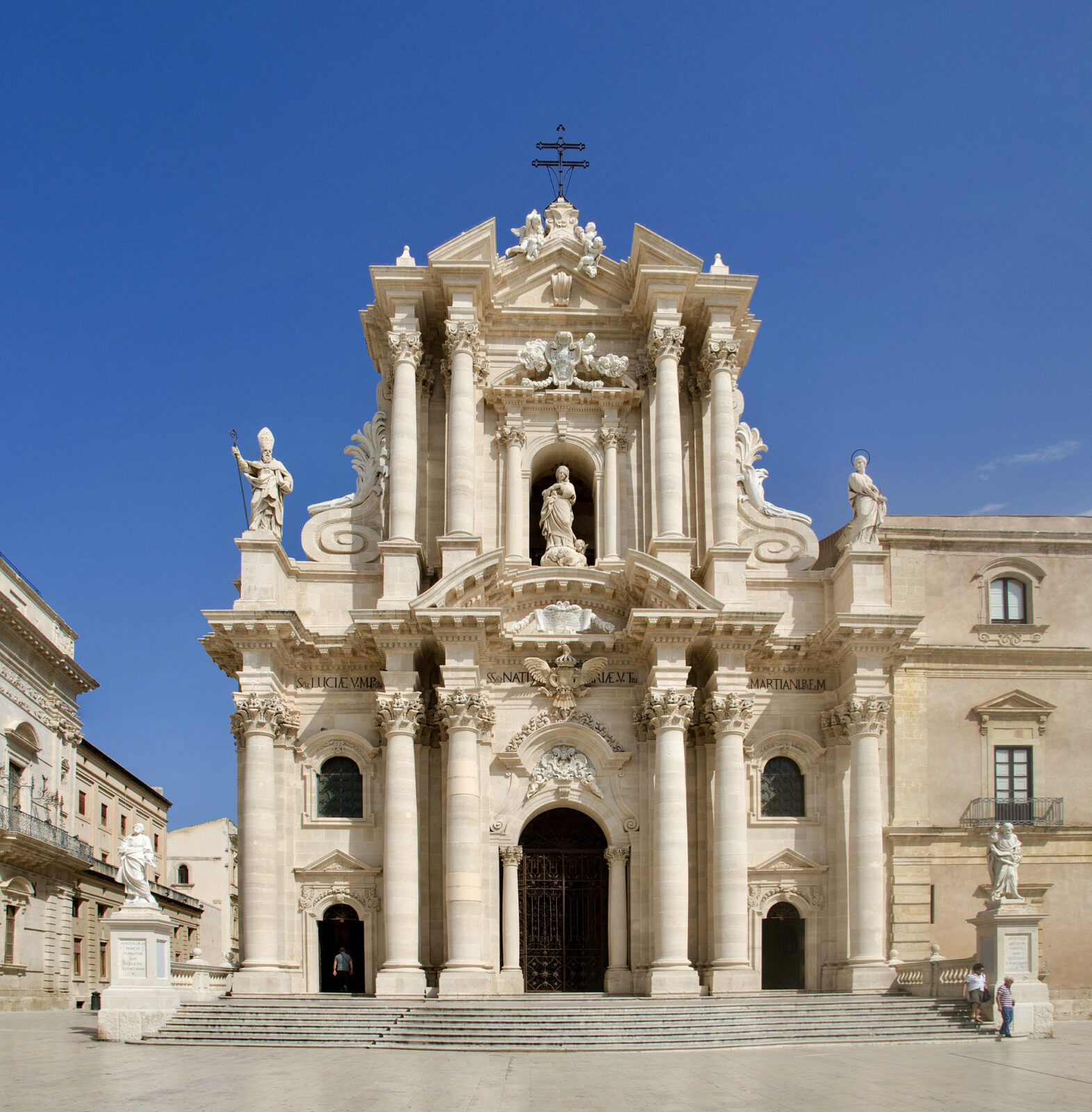
Pascasio, the prefect, knowing that she was noble, rich and seeing her beauty, at first treated her with kindness. But slowly as the trial proceeded, it was clear that Lucia would not give up her Christian faith, and finally Pascasio ordered her to be dragged and punished.
And it was then that the Holy Spirit made Lucia immovable. The strongest soldiers tried to drag her, they tried to tie her hands and feet and to pull them all together, in the end they even tried with a pair of oxen, but nothing. The girl stayed where she was!
The prefect, very angry and convinced it was the work of a witch, ordered that she be burned alive on the spot.
But the flames did not take hold of Lucia’s clothes or body. Finally, blinded by rage, Pascasio had Lucia killed with a dagger to the throat.
But before dying, with her last words, the Saint prophesied the imminent end of the persecution against the Christian church, with the fall of the Emperor Diocletian. It was Dec.13, 304 and since then the day is dedicated to the Holy Martyr.
The mother, Eutichia, buried her daughter and on the tomb she had a dove carved, to symbolize the peace that Lucia had prophesied.
And in fact, a short time later, peace was given to the Christian church by Constantine. On the spot where the martyr had given her soul back to God, a temple was erected and the following of Saint Lucia spread rapidly throughout Christianity.
Santa Lucia is the patron Saint of Syracuse, Sicily. Lucia means light, and as such, she is also the patron Saint of the blind.
Make the pledge and become a member of Italian Sons and Daughters of America today.
(Photo credit: pjt56)
