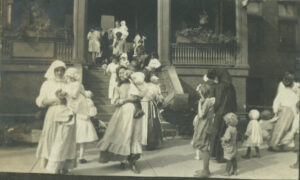

By Pamela Dorazio Dean, Italian American Museum of Cleveland
In Cleveland, Ohio, prior to the formation of the city’s present day Little Italy, Italian immigrants settled in an area called Big Italy, located to the south and west of Public Square, in what was known as the Haymarket District. Prior to 1880, the neighborhood was primarily Jewish, but as the Jewish population moved on to better neighborhoods, the Italian immigrants moved in. By 1900, the population was 93% Sicilian.
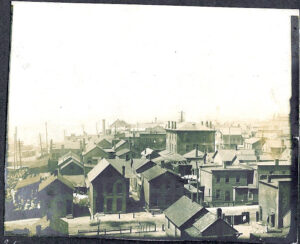
Very little physical evidence remains of this first Italian settlement of Cleveland. Only the red Romanesque building that once housed St. Anthony’s Church, built in 1904, still stands. Currently occupying what was Big Italy are many newer developments, including Progressive Field, the Interstate highway, and Cuyahoga Community College.
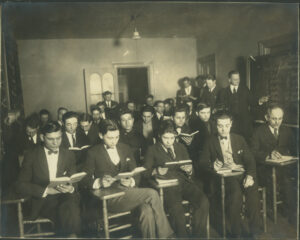
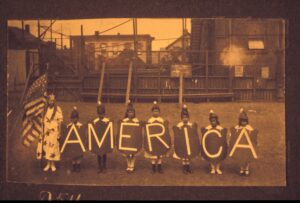
Thanks to the Hiram House, we can see what this neighborhood looked like and view some of the faces of its residents. Hiram House was a social settlement located on Orange Avenue, established by George Bellamy in 1896. Luckily for us and future generations, Bellamy and other staff documented the events, people, and the neighborhood itself not only through written reports but through photographs. He used the photographs to argue for funding for the settlement and for social change.
In the 1970s, the Western Reserve Historical Society in Cleveland, Ohio, acquired the photographs. They placed them in acid-free containers and catalogued them, so they could be accessible to the public. As we celebrate Italian American Heritage Month, it’s important to remember these early immigrant communities and reflect upon the kind of life Italians experienced during their first years in America, when nothing came easy.