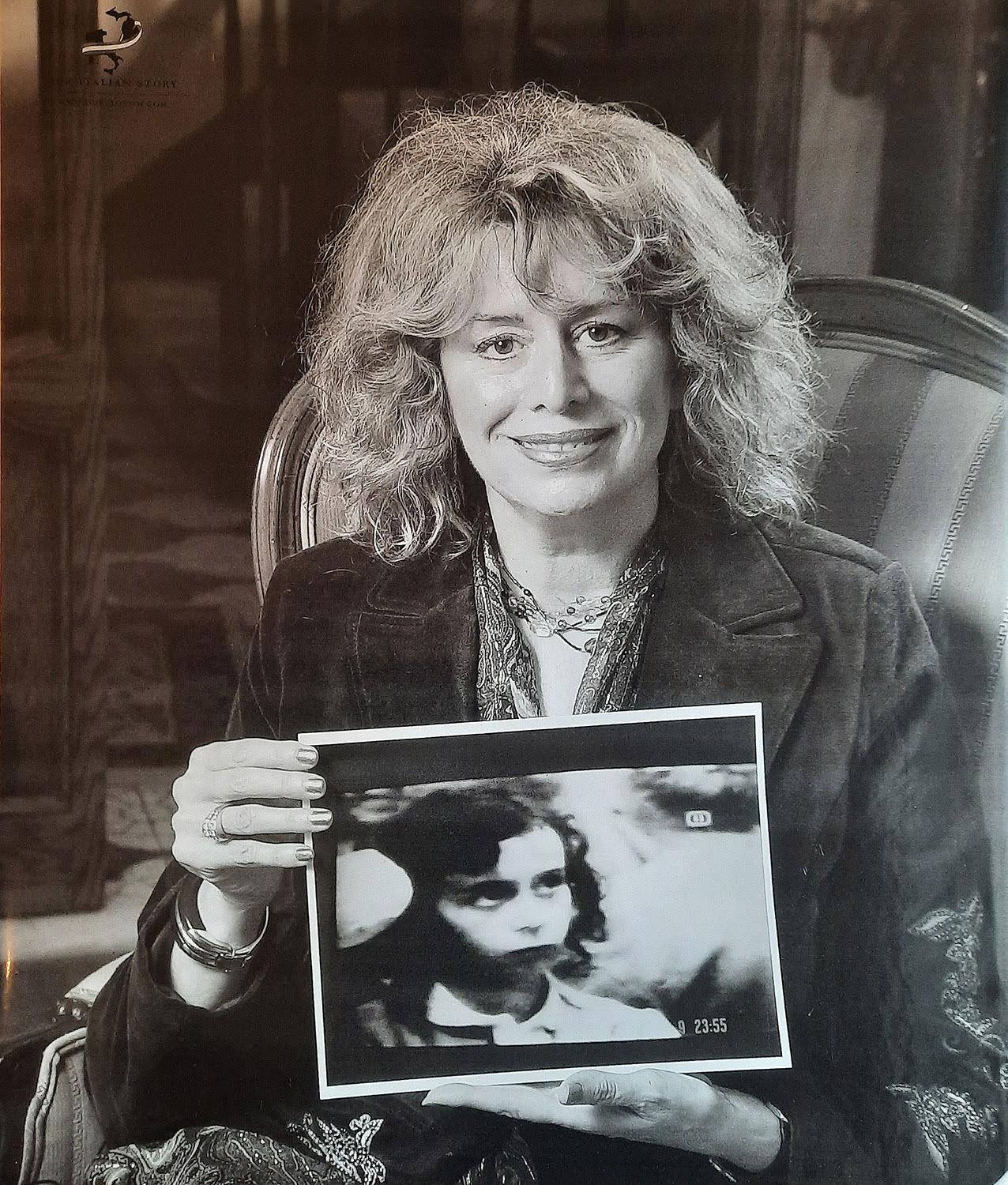
By Pierette Domenica Simpson, La Nostra Voce
“It was the longest day of my life. Words alone cannot convey the tortured moments of that morning of July 26, 1956, when I heard about the sinking of the Andrea Doria. Finally, the good news came: the telegram from the Ile de France read ‘TUTTI SALVI.’ I knew you were saved.” -Vivian Massa, Pierette’s mother
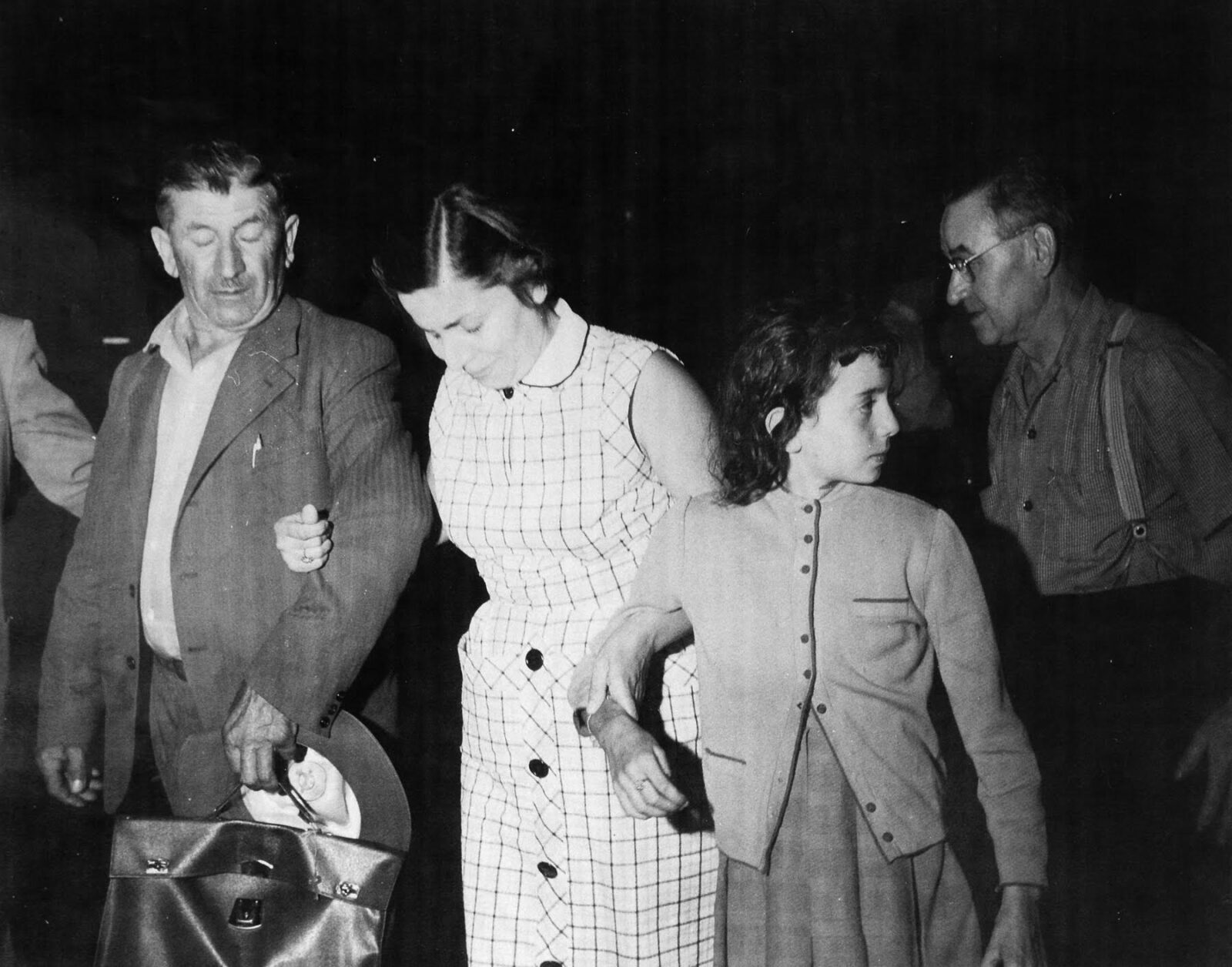
My nonnis and I had survived the collision and thus became part of the “greatest sea rescue in peacetime history.” But the loss of life and the crown jewel of the Italian Line shocked the world.
Ironically, upon her maiden voyage in 1953, the Andrea Doria impressed the maritime world for its modern technology with not only its peak speed of 23 knots, but by its two sets of steam turbines and two radars. It was designed for safety, meeting all requirements of the International Convention for the Safety of Life at Sea. Just as with the Titanic, some even dubbed the ship “unsinkable.”
The Andrea Doria was designed by Italy’s greatest artisans to exemplify the beauty of the Italian spirit inspired by centuries of artistic magnificence. In fact, it was called “a floating art museum” with works reflecting Italy’s artistic heritage of painters, ceramists, sculptors, and designers. It was a prestigious choice of travel by the rich and famous, such as screen stars Anna Magnani, Ruth Roman, Betsy Drake, Cary Grant, Tyrone Power, Orson Wells, Spencer Tracy, Richard Widmark, and Joan Crawford.
At each of her ports — Genoa, Cannes, Naples, Gibraltar, and New York — the liner gracefully displayed its sleek lines.
She was unquestionably the symbol of Italy’s revival from the economic ruin of WWII. Her demise was devastating to the Italian soul!
My mother, Vivina, had emigrated from Piemonte eight years earlier (1949), when I was 15 months old. She would send letters from Detroit, Michigan, asking my grandparents who had adopted me, to bring me to America by ship or allow me to take a plane. But I would protest the latter, screaming that air travel was not safe! She kept promising us that we too would realize the American Dream. The final demand included three tickets for passage on the Andrea Doria. We traveled eight days in comfort and fun, especially since even Third Class had a swimming pool.
On July 25, 1956, the last full day on board the cherished Italian liner, our spirits were covered with a gloomy blanket of fog that even permeated the corridors.
11:10 p.m. near the Nantucket Shoals
“I know this song…Arrivederci Roma. Guess we’re saying goodbye to Italy for good. I’m excited; I get to see my mother, new baby sister, and stepfather tomorrow. Nonna finally looks relaxed…wish Nonno hadn’t gone to sleep early…he said, ‘Tomorrow’s going to be a big day’…What’s that noise?!”
I cried and trembled, along with all the astonished passengers who instantly froze into statues of fright, swaying from an abrupt jolt and hearing a thunderous noise. Those who were on the outer deck stood witness to startling fireworks created by grinding steel from another ship that had slammed into our hull at full speed. They watched in horror as the perpetrator tried to withdraw from the hole it had created, slicing through thick walls of steel that had once protected passengers from the dangers of the Atlantic Ocean. The gruesome spectacle was magnified by the crash of hundreds of bottles that landed on the bar floor, as if put there by the devil’s rage. Every fiber in our spines reacted to the scraping, screeching, and crunching noises from some indefinable source.
After what seemed like eternity, my nonnis and I sat on the floor in prayer circles of the already heavily inclined liner; the Ave Maria’s last words, “….now and at the hour of our death” suddenly took on an eerie meaning. Afterall, we did not know that Captain Piero Calamai had sent out an SOS and rescue ships were on their way. For 1,640 passengers they were angels of mercy; tragically, 46 lives could not be spared on the Doria.
Even after 66 years, I quiver when I recall my frail, 9-year-old body dangling from a rope around my waist over the black ocean. Fortunately, I didn’t understand the concept of drowning, but the intense screams from above and below signaled a great danger. As my life was literally in suspension, I screamed for my nonnis and they screamed something back. But the violent waves pounding against the ship’s smashed hull created by the Stockholm’s penetration muffled any words of confidence.
As I began to approach the black waters, I thought I was going to be dropped into the ocean! I could not see the Ile de France lifeboat below that was hidden under the steeply inclined liner (perhaps 40 degrees by now). A sailor’s hands pulled me in to join people hysterically crying, screaming, and vomiting, many wearing only underwear or curtains on their backs.
Miraculously, my nonnis, in a desperate attempt to join me, grabbed ropes and lowered themselves into the swaying lifeboat. When I recall my nonna’s lifelong paranoia of water, I marvel at her courage. And my nonno’s sense of duty to the family managed to descend with his briefcase in hand, but his piercing blue eyes reflected unimaginable fright!

I admit that I worried about my First Communion dress and hoped it would be recovered somehow, but the quagmire of soggy suitcases, open trunks, and other debris was not reassuring. Moreover, during this ride from hell to the Ile de France, we were privy to a sight worse than in any disaster film: the Stockholm, a Swedish ship that had rammed us, stood crippled in the distance with its bow crumpled like tin foil. On the Doria, the area of impact was an enormous black hole, inviting in tons of water per hour. And its huge funnel was so inclined over the water that it reflected a red-hot glow on the calm sea.
Undoubtedly, it could have been another Titanic; but thanks to an admirable captain and crew, the Stockholm rescuing around 500 passengers, and the many rescue ships that rushed to our aid from the New York area, the human loss — compared with many other large disasters — was miraculously low.
Yet, the Andrea Doria tragedy remained one of the most complicated and controversial collisions at sea. How could this happen on such a large ocean? My research, based on interviews with maritime experts in both Italy and the U.S. and with the scrutiny of a computer simulation at the U.S. Merchant Marine Academy in New York, revealed how the Stockholm’s crew contributed to the collision:
- The captain assigned an inexperienced Third Officer and two other young men to the bridge in fog; he remained in his cabin even while in the most trafficked area near the Northeast coastline (approximately 50 miles from the Nantucket Shoals)
- The young men were overworked and overwhelmed
- The Third Officer was directed to navigate in a lane designated for westbound traffic, thus in our lane as they traveled eastward
- The Stockholm had an antiquated radar that had to be set by hand, with a flashlight to determine position of vessels
- Its foghorn was silent, although prescribed by maritime law
- The Third Officer misread his radar, thinking the Doria was approaching on his left; he mistakenly ordered two right turns which led to the shocking collision, at full speed
These fatal errors were predicated on miscalculations in distance, position, weather, and timing. The result was Murphy’s Law at its worst.
There should have been a trial, but Lloyds of London — the insurer for both the Stockholm and Andrea Doria — decided that there was not enough evidence to ascertain guilt. Hence the most complicated maritime disaster was settled swiftly with a no-fault verdict, even after four months of hearings. The terms of the agreement were to be kept secret. Passengers were compensated a meager $6 million for loss of life and property, instead of the $115 million they had requested in 1956.
Nevertheless, Captain Calamai awaited the earlier promise to command the new sister ship of the Doria, the Cristoforo Colombo, but the request never arrived. Feeling abandoned and vilified, ashamed to have tarnished the name of the long line of Calamai men and their distinguished naval career, he exclaimed to the media, “I used to love the sea, and now I hate it.” Calamai admitted himself to the hospital complaining of malaise. His last words were “Are the passengers saved?” His family and those who knew him well understood that he had died of “crepa cuore,” a broken heart.
Captain Calamai’s obituary of The New York Times in April of 1972, quoted maritime scientist, John Carrothers:
“The most tragic figure to come out of this disaster was Captain Piero Calamai, master of the Andrea Doria. A victim of circumstances, he was alone, brokenhearted, unable to defend himself… of all the principals involved, companies and individuals, Captain Calamai was the least responsible.”
Thru the years, books and documentaries unjustly assigned blame on the Italian captain and crew. Since the tragedy occurred not long after WWII, there was the stigma of Mussolini, droves of immigrants, and even our Catholicism; moreover, they were described as cowardly, emotional, illogical, and dishonest. It was easy, then, to find a scapegoat in Captain Calamai. He was guilty by the fact that he was Italian.
In my quest to ascertain the truth, I dedicated the last 19 years to learning how to write and publish, and later how to make a documentary. My works are intended to set the historical record straight and restore the honor due to Captain Piero Calamai, his crew, and the Ansaldo shipbuilders — all possessing Italian maritime brilliance that elicits names like Amerigo Vespucci, Marco Polo, and Christopher Columbus. Less famous in name, but not forgotten, is the tenacity of Admiral Andrea Doria, who in the 1500s crossed oceans on warships in the name of Genoa, to protect what was then an Italian republic. Ironically, the namesake of the Andrea Doria lived to be 94 years old while the Doria lived only three.
We acknowledge these courageous Italian seamen for centuries of navigation and for our privilege to enjoy sea travel.
About the author: Ms. Simpson lives near Detroit, MI. with her life companion Richard Haskin. She stays in touch with her family and friends in Italy, visiting whenever possible. After teaching foreign languages for 37 years, she authored the non-fiction and fiction books, Alive on the Andrea Doria: The Greatest Sea Rescue in History, I Was Shipwrecked on the Andrea Doria, and produced the docufilm “Andrea Doria: Are the Passengers Saved?”
Simpson is currently collaborating with the Noble Maritime Collection of Staten Island, where an Andrea Doria exhibition is being held until June 2023. Meanwhile, she writes and is interviewed for radio, podcasts, and television. Her dream is to have a feature film or TV mini-series based on her award-winning books and docufilm.