

Salvatore Ferragamo’s Rainbow Wedge sandal was crafted in 1938 for Judy Garland. Italian fashion, for the first time since the Renaissance, was celebrated internationally thanks to Ferragamo. At the height of his career, monarchs, movie stars, presidents and socialites flocked to Florence to admire his creations and place their orders.
By Laura Vinti, La Nostra Voce
The Italian steamship Stampalia seemed enormous to the small dark boy hailing from Bonito, but that didn’t scare him: it seemed only fitting that the vessel was almost as big as his dreams. It was 1915, Salvatore was not 17 yet, and he had only 150 liras in his pocket — about $30. With a suitcase full of his mother’s cooking and a head filled with hope, he looked forward to his future. He wanted to make shoes, and America, vast and new, seemed like the right place to go.
Salvatore’s love affair with shoes had started many years before, when he was still a small child. His mother knew that he could always be found in Luigi Festa’s workshop, fascinated as he was by the local cobbler’s ability to craft shoes. Barefoot, curious, and barely able to walk, he already knew with startling clarity that one day he would be a shoemaker — the best of all.
In Bonito, about 60 miles east of Naples, school ended with third grade, and only the wealthy could afford to send their children to Naples to continue their education. Salvatore’s parents, Antonio and Mariantonia, were poor farmers, and he was the eleventh child of fourteen. By the time he had completed his abridged education, his older brothers and sisters had all left for America. Salvatore had no wish to leave his family: his all-consuming desire was to be apprenticed to Festa.
This article first appeared on the front page of the June 2024 edition of ISDA’s monthly Italian American newspaper, La Nostra Voce. Subscribe here
Unfortunately, that was the one desire his parents were not willing to grant: “Choose a respectable trade!”, they would say. “You can be anything you want, but not a shoemaker!” Making shoes was the lowest of all trades; a shoemaker son would bring disgrace to his entire family, no matter how humble his family already was.
But Salvatore was nothing if not headstrong: it was his curse, and his strength. The night before his younger sisters’ Communion, Mariantonia had still not been able to borrow white shoes for her daughters. In his eagerness to help his distressed family, the 9-year-old saw his chance. After dinner, when everybody else was busy, he ran to Luigi Festa’s workshop and obtained all he needed to make two pairs of white shoes for his sisters. He waited until his family went to bed, and then he worked through the night. By the next morning his sisters’ white shoes were admired by the entire village. Surprised and deeply touched, Antonio and Mariantonia caved in. The next morning, the boy was apprenticed to Signor Festa.

But Bonito was too small for Salvatore’s ambition and talent. At 11, having learned all that Festa could teach him, he moved to Naples, but even there, after two weeks in the shop of the best Neapolitan shoemaker, he had mastered the finest subtleties of the craft. Learning felt like remembering. He must have been a cobbler in a previous life: this was the only way he could explain it.
He went back home to Bonito not quite 12, opened his own shop in his family’s house, and hired two assistants: an 18-year-old boy with previous work experience, and an 8-year-old boy whose task was to straighten used nails. However, it didn’t take him long to realize that he could only grow his business so much in his small village. His brother Alfonso, who was working in a shoe factory in Boston, wrote about the wonderful machines that could speed up Salvatore’s work and allow him to increase his output dramatically. At first reluctant to leave Bonito and his family, Salvatore at last decided that he would go to America, learn all that he could in that land of wonders, and bring the new technologies back to Italy, where he would then become rich and famous.
It didn’t quite go as expected. Once in Boston, he visited the shoe factory where his brother had worked and was horrified. This had nothing to do with talent, craft, and beauty! He hated the crudely mass-produced shoes, the repetitiveness of the work, the clunky machines, the deafening noise. To his sisters’ and brother-in-law’s dismay, he decided at once that he would travel west and join his three older brothers who, in the meantime, had moved to Santa Barbara, California.
As it so happened, Santa Barbara was the film production center of the American Film Manufacturing Company. Salvatore’s brother Alfonso sometimes worked for them, ironing suits for the actors. Salvatore was adamant that he would only work as a shoemaker, and since in America only the rich could afford hand-made shoes, the brothers hoped that the film industry might need someone to custom-make shoes for their productions. Alfonso introduced Salvatore to the wardrobe director, and together the three toured the studios, which specialized in shooting westerns. Surrounded by movie sets and props, Salvatore felt immediately at home. When his eyes fell on a pair of cowboy boots, he was enthralled; he had never seen them before. He admired the style and the quality of the leather, but realized at once that he could create much better boots. He pointed out how he would improve them, and when his brother translated his words to the wardrobe director, the man’s eyes lit up. “These boots are always wrong! They are made in Eureka, and when they arrive, they either don’t fit, or they are the wrong style!” He was enthusiastic about having a shoemaker working close by. He patted the boy’s back genially, shook his hand, and welcomed him into the golden world of silent movies.
After Westerns came shoe orders for historical epics, costume films and cloak-and-dagger stories. He created fabulous shoes for roles played by Rudolph Valentino, Douglas Fairbanks, Mary Pickford, and Barbara La Marr, and he invented brand new models for Cecil B. DeMille’s biblical and religious epics, such as The Ten Commandments and The King of Kings.
His shoes were stunning — and comfortable. Up until that moment, shoes had been either beautiful or comfortable. Salvatore’s creations managed to be both. It didn’t take long for actors to desire the same comfort and style even when they were off-stage. The first to order shoes as a private customer was Lottie Pickford, Mary Pickford’s younger sister. Soon thereafter, he was making shoes for every actor working for the studios.
Spurred by his success and his fascination with feet, which he saw as one of God’s masterpieces, Salvatore decided to enroll at the University of Southern California in Los Angeles to study the anatomy of the human body. He loved feet — their strengths, their gracefulness, their ability to support their owner’s weight; he wanted to make shoes that didn’t hurt them. He believed that no one was born with bad feet: calluses, bunions, fallen arches, crooked toes were all caused by bad shoes. He had seen how much suffering was due to bad shoes, and he set out to rectify that.

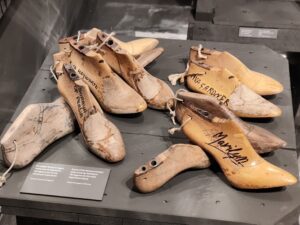
In the 1920s, the studios moved to Hollywood, and he followed. When the silent movies were supplanted by the “talkies,” a new generation of actors debuted in Hollywood. They were young, ambitious, and wealthy; they spent their time acting, partying, marrying, divorcing, drinking, and buying Salvatore’s shoes. Ferragamo was instrumental in sculpting their public personas as they transitioned from talented unknowns to movie stardom. He knew their feet as his own, bunions, corns, and all, and created wooden lasts for each of them: Greta Garbo, Gloria Swanson, Charlie Chaplin, Joan Crawford, Katherine Hepburn, just to name a few. Their ranks were later swelled by icons such as Lauren Bacall, Marilyn Monroe, Sophia Loren, Grace Kelly, Audrey Hepburn, and many, many more.
This was a time when the world had forgotten that Italy had been the cradle of Roman art, culture, and architecture, and the birthplace of such masterpieces as the Colosseum and the Mona Lisa. Fashion was dictated by France, seamstresses and cobblers everywhere were judged by their ability to reproduce French models
Poor Italians streamed into Ellis Island and settled into cramped and dilapidated quarters in New York, Boston, and Philadelphia; they were looked down upon and considered members of an inferior race. Salvatore, however, unbeknownst to him, was following a long and illustrious Italian tradition. Ever since the Renaissance, many Italian artisans had transcended the boundaries of their craft and become inventors and creators, and the best among them had enjoyed a high social standing. Leonardo, Michelangelo, Raphael had all been on friendly terms with their powerful patrons, who admired their genius and respected their art.
The poor, barefoot Italian boy from the south of Italy had achieved the same status. He was an artist and an inventor. He loved to play with shapes and styles. He held more than 20,000 models in his shoe library and registered more than 300 patents. He overcame any hurdle with grit and determination, turning obstacles into inspirations. Spurred by the shortage of high-quality materials during the autarky years in Italy right before World War II, Salvatore experimented with textiles, animal skins, raffia, nylon, and paper. In 1937, he patented his iconic cork wedge, arguably his most recognizable creation.
He was a trailblazer, and the world was not always ready for his creations. But in 1947, he received the highly coveted Neiman Marcus Fashion Award, one of the highest recognitions in the fashion industry. The French fashion designer Christian Dior was awarded the same honor that year, and he and Ferragamo were the first non-Americans to receive the prize. For the first time since the Renaissance, Italian fashion was celebrated internationally. Long before Prada and Gucci became well-known names, it was Ferragamo who put Italy back on the world’s fashion map.
In Florence, an exhibition at Palazzo Spini Feroni celebrates his life and accomplishments — 1898-1960 Salvatore Ferragamo, Museo Ferragamo, which runs until November 4th, 2024.
Learn more at: https://museo.ferragamo.com/en
