
By John Deike, Editor, La Nostra Voce
Through much of the 20th century, Christopher Columbus stood among the most admired figures in American culture. Cities erected monuments in his honor. Schoolchildren learned about his courage and vision. Italian Americans embraced him as a symbol of pride and acceptance in a nation where their families had faced widespread discrimination.
Today, that legacy is under relentless attack.
Across the U.S., Columbus statues have been removed, vandalized or destroyed. Columbus Day has been renamed or replaced in numerous states and municipalities. In many classrooms and comment board discussions, Columbus is presented not as one of history’s greatest navigators but primarily as a symbol of conquest and oppression.
This article first appeared in the September 2026 edition of La Nostra Voce, ISDA’s monthly newspaper covering Italian American news, culture, history and recipes. Subscribe today.
Lost amid the controversy is a simple historical reality: Few individuals have changed the course of human history as profoundly as Christopher Columbus.
His voyage in 1492 permanently connected Europe and the Americas, two worlds that had developed independently and remained unknown to each another for thousands of years. The resulting exchange of foods, animals, technologies, ideas, cultures and peoples reshaped the world.
Crops from the Americas helped feed populations across Europe, Africa and Asia. Potatoes, tomatoes, corn, cacao (chocolate), tobacco and countless other goods crossed oceans. New sailing and trade routes emerged, some of which are still used to this day. Entire economies were transformed and new nations, most significantly the United States, arose as the Old World became the New.
Historians refer to this process as the Columbian Exchange, a watershed moment in world history that also carried unintended consequences, including the spread of diseases that claimed many lives.
Yet in contemporary discussions, these achievements are often omitted. Instead, Columbus is frequently portrayed as history’s chief villain, as though the complex realities of exploration and empire began and ended with him.
The Howard Zinn Revolution
No individual did more to alter Columbus’s legacy than historian Howard Zinn.
In A People’s History of the United States, Zinn devoted only a small portion of his sprawling book to Columbus, yet those opening pages had an outsized influence on generations of Americans.
Millions of students encountered Columbus through Zinn’s interpretation (the veracity of which has faced serious questions over the years), which placed exploitation of Indigenous peoples at the center of the story while devoting comparatively little attention to the explorer’s world-changing accomplishments.
The result was a dramatic shift in public perception.
Within a generation, Columbus went from being widely celebrated to becoming one of the most controversial figures in American history.
But history deserves to be understood within the context of the time in which Columbus actually lived.
A Different World
There’s a chasm between the 15th century and the 21st.
Forms of slavery existed in societies across Europe, Africa, Asia and the Middle East. Conquest was a normal feature of political life. Empires rose and fell through warfare. Concepts of human rights as we understand them did not exist.
Recognizing this context is not the same thing as endorsing everything people did within it. It is simply what historians routinely do: understand people within their time rather than pretending they lived in ours.
Few people argue that Julius Caesar should be erased from history because he conquered Gaul. Few demand that Alexander the Great disappear from public commemoration because his military campaigns brought suffering. Napoleon Bonaparte remains a towering figure in French and European history despite the staggering human cost of the wars associated with his reign.
Yet Columbus is increasingly judged by a different standard.
He has become a convenient vessel into which centuries of European colonization and injustice can be poured, even though much of that history occurred long after his death.
The History Often Left Out
The question of historical consistency becomes particularly important when discussing the Indigenous societies of the Americas.
Popular accounts of the Columbus story can leave audiences with the impression that he arrived in an essentially peaceful world. The historical and archaeological record tells a more complicated story.
The pre-Columbian Americas contained extraordinary civilizations. Indigenous peoples built sophisticated cities, developed political systems, created vast trading networks and made remarkable advances in agriculture, engineering, mathematics and astronomy.
But these were human civilizations, not utopias.
Long before Columbus crossed the Atlantic, warfare, conquest, captivity and forms of slavery existed in the Americas. Powerful Indigenous states conquered neighboring peoples, demanded tribute and fought for territory and political dominance.
Human sacrifice, and even some cases of cannibalism, also existed in pre-Columbian civilizations.
The practice is particularly well documented among the Aztecs and is also documented in certain Mayan and Andean societies. Archaeological discoveries have provided physical evidence that such widescale sacrifices occurred centuries before Europeans arrived.
These facts do not diminish Indigenous accomplishments or justify the mistreatment Native peoples later endured. They do, however, challenge an overly romanticized version of the pre-Columbian world.
And there is another uncomfortable chapter of this history that receives considerably less public attention.
Native American Slaveholders
Perhaps most surprising to many Americans is the documented history of Native American ownership of Black slaves.
The Smithsonian Institution examined this subject directly in 2018, highlighting the participation among the Cherokee, Chickasaw, Choctaw, Creek and Seminole nations in African slavery.
Members of these nations owned enslaved Black people, enacted slave codes and incorporated slave labor into parts of their economies. Some Native Americans became substantial slaveholders, and several of these nations ultimately allied themselves with the Confederacy during the Civil War.
Among the most striking examples is Cherokee Chief John Ross.
Ross is remembered for courageously opposing the forced removal of the Cherokee and fighting the policies that culminated in the Trail of Tears.
He was also a slaveholder.
Those two facts can coexist.
Ross was the victim of a terrible persecution committed against his people, who simultaneously participated in an institution that inflicted deep injustice and suffering on others.
That is precisely what makes history so challenging, and so important.
Why, then, do these subjects occupy so little space in many of today’s discussions of Columbus and Indigenous history?
It is a question worth asking.
Native scholars and institutions, including the Smithsonian’s own Native American curators, have confronted these difficult subjects, so it would be unfair to suggest Indigenous people universally avoid these inconvenient truths. Yet the history of Native American slaveholding, Indigenous warfare and pre-Columbian violence remains conspicuously absent from much of the popular debate surrounding Columbus.
Perhaps the explanation is relatively simple: Complexity makes advocacy difficult.
A story divided neatly between oppressor and oppressed is easy to communicate. A history in which people can simultaneously suffer injustice and perpetrate it is much harder.
Why Columbus Matters to Italian Americans
For Italian Americans, the attacks on Columbus are especially painful because critics often fail to understand what Columbus came to represent.
The holiday was never simply about a 15th-century navigator — it was about immigrant dignity.
During the great waves of Italian immigration in the late 19th and early 20th centuries, Italians encountered widespread prejudice in the United States. They were stereotyped, mocked, excluded and subjected to violence.
That hostility reached a horrifying crescendo in New Orleans in 1891.
Eleven Italian immigrants were murdered by the largest lynch mob ever to assemble on U.S. soil after a court refused to convict them of killing Police Chief David Hennessy. The massacre, which unfolded in the streets of New Orleans in front of thousands of people, became one of the largest mass lynchings in American history and sparked a diplomatic crisis between the United States and Italy.
The following year, President Benjamin Harrison proclaimed a national observance commemorating the 400th anniversary of Columbus’s voyage.
More than a century later, the White House itself would explicitly connect these events. President Joe Biden’s Columbus Day proclamations noted the 1891 lynching and stated that Columbus Day parades were created by Harrison partly in response to anti-Italian violence.
Over a million people attended Harrison’s New York City parade in 1892, providing Italian immigrants with an opportunity to publicly celebrate an Italian-born figure who had played an extraordinary role in the history of the Americas.
At a time when Italians were routinely treated as outsiders, Columbus became a symbol of acceptance.
He represented achievement.
He represented perseverance.
He presented a path to assimilation.
The statues, parades and civic celebrations built around Columbus were not created by generations of Italian Americans to glorify colonialism.
They were expressions of ethnic pride by a community that had endured prejudice and fought for its place in American society.
This context is too often absent from today’s debates.
Critics may look at a Columbus monument and see only conquest. Many Italian Americans see something quite different.
They see their grandparents and great-grandparents, people who arrived with little, endured discrimination, worked difficult jobs, built families and communities, and ultimately became part of the fabric of American life.
The campaign against Columbus rests too often on an incomplete reading of history, and the answer is not to erase him.
Turning the Tide for Columbus
The debate is far from over.
In fact, Italian American advocates have begun scoring significant victories in cities where Columbus Day and Columbus monuments came under threat.
Basil Russo — the national president of Italian Sons and Daughters of America (ISDA), who has gone on to forge a nationwide Italian American advocacy coalition — was at the center of the successful 2019 effort to preserve Columbus Day in Cleveland, Ohio, after city council members initially proposed replacing it with Indigenous Peoples’ Day. Following swift opposition from the Italian American community, the city retained Columbus Day while establishing Indigenous Peoples’ Day on Aug. 9.
Russo’s advocacy later expanded nationally through the Conference of Presidents of Major Italian American Organizations (COPOMIAO), an umbrella organization he leads that represents 77 Italian American groups.
In Philadelphia, COPOMIAO and fellow plaintiffs challenged former Mayor Jim Kenney’s executive order eliminating Columbus Day as an official city holiday and replacing it with Indigenous Peoples’ Day. In August 2025, Pennsylvania’s Commonwealth Court unanimously reversed a lower court’s dismissal of the case, which immediately restored the Columbus Day holiday in the city.
Another major legal victory came in Pittsburgh.
After city officials moved to uproot the 30-foot Columbus monument in Schenley Park, the Italian Sons and Daughters of America went to court. In 2024, a seven-judge Commonwealth Court panel unanimously revived ISDA’s legal challenge and sent the case back to the lower court for further consideration, keeping alive the effort to preserve the monument.
Then came perhaps the most visible victory yet.
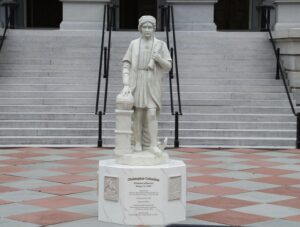
In March 2026, Russo and COPOMIAO helped spearhead the installation of a replica of Baltimore’s toppled Christopher Columbus statue on the White House campus, in front of the Eisenhower Executive Office Building.
The original monument had been unveiled by President Ronald Reagan in 1984 and destroyed during civil unrest in 2020. Its replica’s installation near the White House, undertaken in coordination with Italian American Organizations United and the Trump Administration as part of the nation’s America250 commemoration, transformed a symbol of destruction into one of restoration.
The legal fight has expanded elsewhere.
COPOMIAO National Counsel George Bochetto filed a federal lawsuit in April 2026 seeking the return of Columbus, Ohio’s namesake statue. The 22-foot bronze monument, created by Italian sculptor Edoardo Alfieri and gifted to the city by Genoa in 1955, was removed from City Hall grounds in 2020 and placed in storage.
Russo’s advocacy has also reached the White House across presidential administrations.
During the Biden Administration, Russo met with federal officials to emphasize the significant and often overlooked historical connection between Columbus Day and the Italian American experience.
The resulting Columbus Day proclamations in 2022, 2023 and 2024 placed emphasis on that history.
The 2022 proclamation specifically recalled Columbus’s Genoese roots, the pride his voyage has inspired among Italian Americans, the discrimination Italian immigrants encountered in the United States and the 1891 New Orleans lynching.
The 2023 proclamation went even further, opening with a celebration of Italian Americans and explicitly connecting President Harrison’s 1892 observance with the murder of 11 Italians in New Orleans the previous year.
Those words mattered.

Now, this history is increasingly becoming part of the national record.
Additionally, COPOMIAO, in collaboration with the Native American Guardians Association (NAGA), has opened intercultural dialogues on our shared history, helping to broaden and deepen the conversation. Surveys conducted through these efforts show that NAGA, which has thousands of members and followers, doesn’t view Columbus with the same level of concern often reflected in reformist and activist movements.
From Cleveland to Philadelphia, Pittsburgh to Columbus, and all the way to the White House, Italian Americans are pushing back against the notion that Columbus’s legacy has already been decided.
They are asking for something both simpler and more difficult: the whole story.
To learn more about the history of Christopher Columbus, read Columbus and the Quest for Jerusalem, written by Carol Delaney, an emeritus professor from Stanford University and research scholar from Brown University.
Make a Pledge and join Italian Sons and Daughters of America today.
