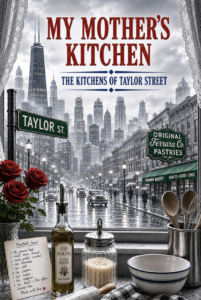
My Mother’s Kitchen: The Kitchens of Taylor Street, by Louis Scalzo
Review by Pamela Dorazio Dean
By the turn of the 20th century, Chicago was home to one of the largest Italian immigrant populations in the United States. Between 1880 and 1920, thousands of immigrants from Southern Italy settled along Taylor Street on the city’s Near West Side. At its height, nearly one-third of Chicago’s Italian immigrants lived on and around that street, where family, faith, hard work, and food shaped everyday life. Like many ethnic enclaves across the country, Taylor Street gradually changed after World War II due to expressway construction, urban renewal, suburban migration, and the expansion of the University of Illinois. Today, while Taylor Street remains an important symbol of Chicago’s Italian American heritage, much of the vibrant community that once flourished there is only a memory.
Author and former Taylor Street resident Louis Scalzo lovingly preserves what that community once was in My Mother’s Kitchen: The Kitchens of Taylor Street. Part memoir, part cookbook, and part neighborhood history, the book transports readers into the kitchens, homes, and lives of Chicago’s Italian American community during the 1950s and early 1960s. Scalzo writes with a reflective, almost philosophical sense of nostalgia that never feels forced or overly sentimental. His affection for his mother, Taylor Street, and the Italian American kitchen comes through naturally on every page. His memories feel genuine, making it easy for readers to understand why this place remained so important to him.
This review appeared in the July edition of La Nostra Voce, ISDA’s monthly newspaper that chronicles Italian American news, history, culture and traditions. Subscribe today!
As I read the book, I couldn’t help but think about the Italian American kitchen in general and ask myself: are they really that unique? Nearly every ethnic group has cherished family recipes and memories centered around food. Yet there is something about the Italian American kitchen that has become almost iconic. In some ways, Italians and food have become cliché. We joke about the Sunday dinners, homemade sauce or gravy, and our grandmothers feeding everyone who walks through the door. Scalzo reminds us that these aren’t clichés at all. They were everyday life for many Italian American families. The warmth, laughter, conversations, and traditions that unfolded around those kitchen tables were real, and his stories remind us why they have endured for generations.
What better way to experience that kitchen than through the recipes themselves? The second half of My Mother’s Kitchen is devoted to family recipes, but they are much more than a collection of ingredients and instructions. These are not elaborate restaurant dishes or gourmet creations, but simple, home-style recipes prepared by mothers and grandmothers who cooked to nourish their families with love. By the time I reached the recipe section, I found myself wanting to make many of them, not because they were particularly fancy, but because they offered an opportunity to experience a small piece of the world Scalzo so beautifully recreates. In his hands, the recipes become a bridge to Italian American traditions that might otherwise be lost.
For many readers, those traditions have already begun to fade. Not every Italian American was fortunate enough to inherit a box of handwritten recipe cards or grow up with memories of Sunday afternoons in Little Italy. Families moved, neighborhoods changed, and customs gradually disappeared. Scalzo’s book offers something precious to those readers. If family recipes have been lost, these can become part of a new collection. If traditions were never passed down, they can now be embraced and shared with future generations. In that sense, My Mother’s Kitchen does more than celebrate the past. It helps keep those traditions alive.
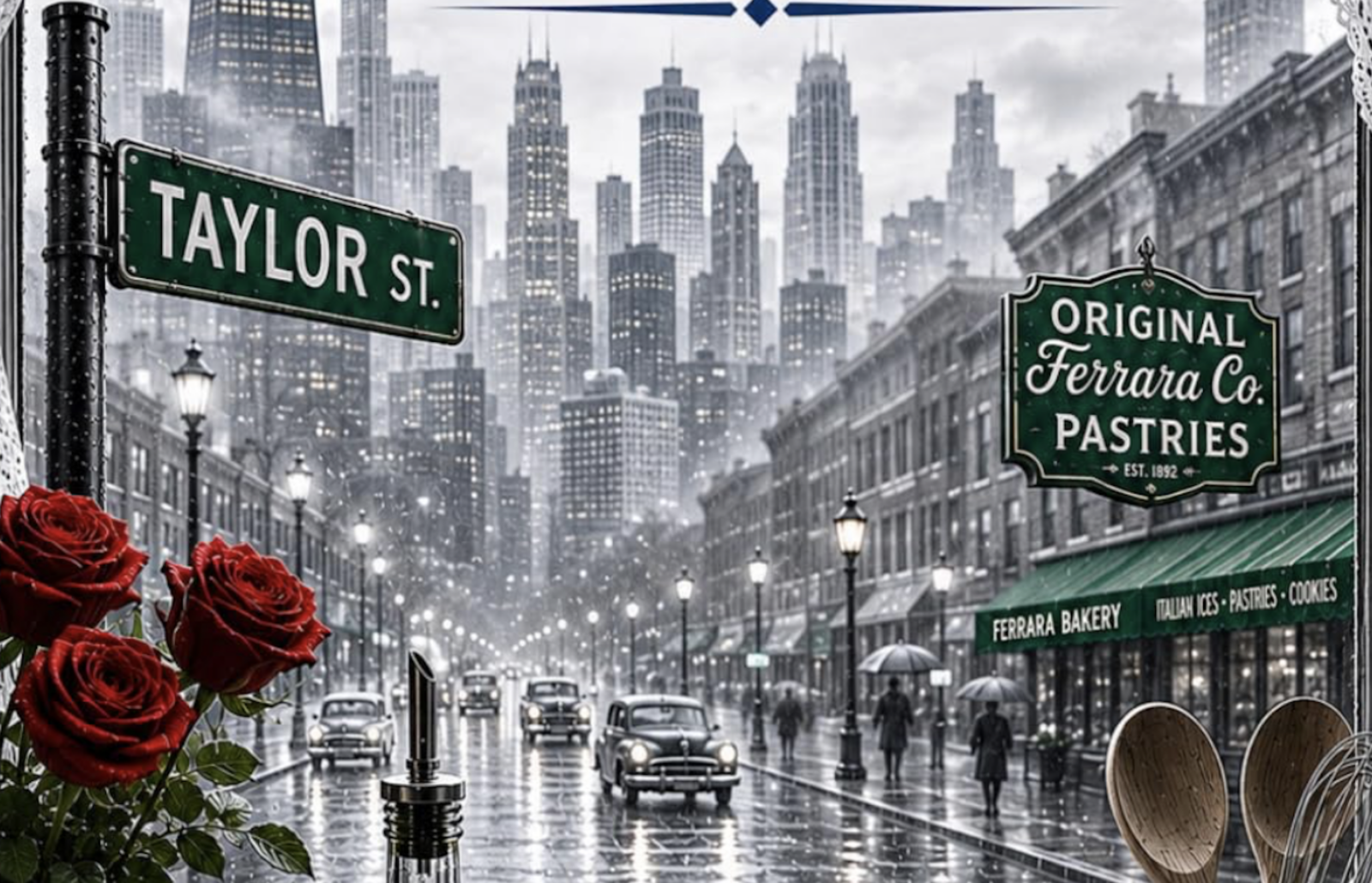
One thing I found particularly interesting was Scalzo’s use of artificial intelligence to recreate scenes from his childhood for which he did not have an actual photograph. In a note at the end of the book, he explains that he used an AI image generator, carefully inputting a description of each scene from his memory. He writes that he was surprised by how closely the generated images matched his recollections and even shared them with others who had lived there, many of whom immediately recognized the scenes. Just as importantly, he clearly identifies the illustrations as reconstructions based on memory rather than authentic historical photographs, a distinction I appreciated. I’m still not sure where I stand on the use of AI in this context, but I appreciate the thoughtful way Scalzo approached it.
Ultimately, My Mother’s Kitchen is a tribute to a way of life that has largely disappeared but continues to live on through memory. It reminds us that the kitchen was never simply a place where meals were prepared. It was where stories were told, values were passed down, families gathered, and culture quietly flourished. Louis Scalzo has written far more than a memoir or a cookbook. He has written a loving tribute to his family, his neighborhood, and the traditions that shaped both. For anyone interested in Italian American history, family traditions, or simply understanding why food remains such an enduring part of our culture, this is a book well worth reading.