
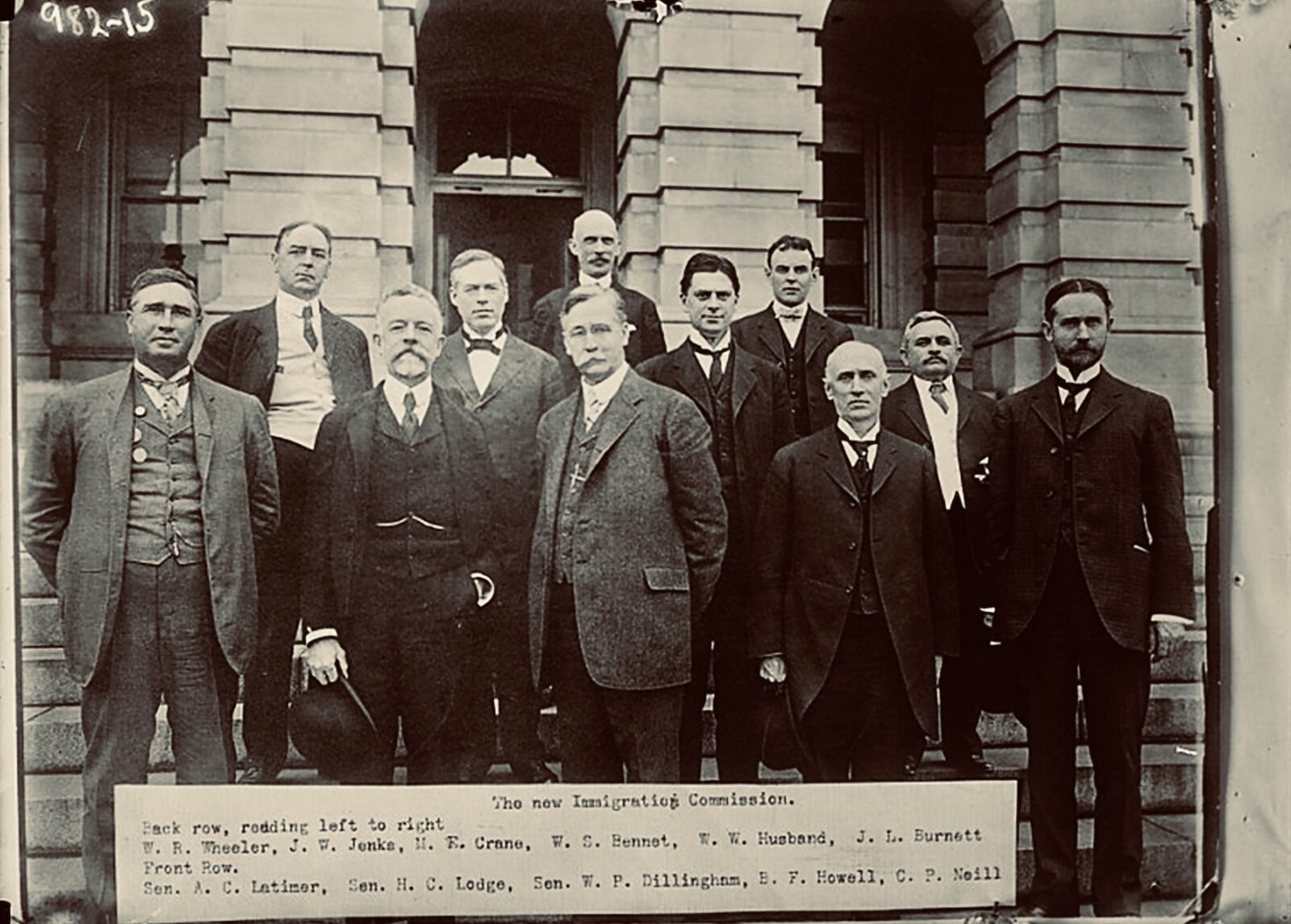
Members of the Dillingham Commission in 1907, named for Senator William P. Dillingham (front row, middle).
By Rich Leto
I have long held a keen interest in early immigration, particularly the period often referred to as the “Great Arrival,” when roughly four million Italians emigrated to the United States between 1880 and 1920. Recently, while conducting family genealogy research and reviewing scholarly works on early immigration, I repeatedly encountered references to the “Dillingham Commission.” This sparked a quest to better understand the now little-known Commission and the role it played in shaping early immigration law reform.
I am grateful that both sets of my grandparents, along with so many other Italian immigrants, arrived in America before the Commission’s recommendations set off the restrictive immigration laws of 1921 and 1924. What follows is a snapshot of what I discovered within the Commission’s drawn-out report — findings that are, at times, deeply shocking.
This article appeared in the June 2026 edition of La Nostra Voce, ISDA’s monthly newspaper that chronicles Italian American news, history, culture and recipes. Subscribe today!
The title of a Smithsonian Magazine article from 2018 by Robert Zeidel sums up the work of the Commission: “A 1911 Report Set America on a Path of Screening Out ‘Undesirable’ Immigrants.”
U.S. Congress in 1907 formed the Dillingham Commission to investigate and study immigration. The Commission took its name from its chair, U.S. Senator William P. Dillingham of Vermont. The Commission was originally comprised of nine members (three more members were later added) and it operated from 1907 to 1911. The Commission collected a staggering amount of data from that time period on southern and eastern European immigrants. The findings, recommendations, and conclusions were contained in 41 volumes of reports (Volume #42 was never published), totaling almost 30,000 pages. These reports included a massive amount of statistical data, along with everything from steamship steerage conditions, living conditions of immigrants, measurements of head size, industries where immigrants worked (coal mining, manufacturing), immigrant homes/banks and aid societies.
When I read the section regarding “Steerage Conditions” (Volume 37), it was difficult to comprehend the grim reality of what our impoverished ancestors endured. The government used federal undercover agents disguised as immigrants that traveled in steerage to report on the conditions. Steerage class, often referred to “third-class” passage, was the cheapest, most unsanitary and most claustrophobic means of steamship travel.
Here are direct excerpts from an undercover agent:
“The vomiting’s of the seasick are often permitted to remain a long time before being removed. The floors, when iron, are continually damp, and when of wood they reek with foul odor because they are not washed. The open deck available to the steerage is very limited, and regular separable dining rooms are not included in the construction.
During days of continued storm, when the unprotected open deck cannot be used at all, the berths and the passageways between them are the only space where the steerage passenger can pass away the time. When to this very limited space and much filth and stench is added inadequate means of ventilation, the result is almost unendurable. Its harmful effects on health and morals scarcely need be indicated.”
Having documented my own Italian immigrant grandparents’ journey in steerage class, the journey across the Atlantic averaged 10 to 14 days. How they and thousands of others endured such horrible conditions is hard to fathom.
What becomes especially troubling when studying the Dillingham Commission is realizing that many of its conclusions were rooted not simply in economics or concerns over assimilation, but in the pseudoscientific racial theories gaining popularity during that era. Southern and eastern Europeans, including Italians, Jews, Slavs, and Greeks, were increasingly categorized as “new immigrants,” viewed by many political leaders and academics as inferior to the earlier immigrants from northern and western Europe.
The Commission ultimately recommended literacy tests and immigration quotas designed to sharply reduce the number of immigrants entering the United States from southern and eastern Europe. Although some presidents initially vetoed such measures, Congress eventually enacted many of the Commission’s recommendations through the Immigration Act of 1917, the Emergency Quota Act of 1921, and the Johnson-Reed Immigration Act of 1924. The 1924 law used the 1890 census as its benchmark (a deliberate move that heavily favored immigrants from northern Europe while drastically reducing immigration from countries such as Italy).
For Italian Americans today, the reports serve as both a historical record and a reminder of how quickly fear and prejudice can shape national policy. Ironically, buried within many of the Commission’s own volumes were findings that acknowledged immigrants’ enormous contributions to American industry, labor, and economic growth. Yet public fear, political pressure, and the growing influence of eugenics often overshadowed the Commission’s own data.
Reading through portions of these reports over a century later, one cannot help but think about the courage of those immigrants who crossed an ocean with little more than faith, determination, and hope. They endured humiliating conditions, suspicion, discrimination, and crushing labor; yet they built families, neighborhoods, churches, businesses, and communities that became part of the fabric of America itself.
