In December 1223, in a rocky grotto near the hill town of Greccio, about 50 miles north of Rome, St. Francis of Assisi staged what is widely considered the first live Nativity scene.
The inspiration came from Francis’ travels to the Holy Land between 1219 and 1220. Moved by the sacred sites associated with Christ’s birth, life and resurrection, he sought to recreate the Bethlehem experience for believers “with our bodily eyes.” By late 1223, while awaiting papal approval for the rule that would establish the Franciscan Order, Francis returned to Greccio, where he had long preached to villagers and shepherds, according to the National Catholic Register.
A Living Nativity
Two weeks before Christmas, Francis asked Giovanni Velita, the local lord of Greccio, to prepare a grotto with a hay-filled manger and live animals, including an ox and donkey. On Christmas Eve, townspeople gathered by flickering torchlight for Mass. Francis proclaimed the Gospel and preached on the humility of Christ’s birth, contrasting the simplicity of the manger with worldly grandeur.
Contemporary accounts, including those by his early biographer Thomas of Celano, describe the event not as a display of statues but as a sensory, living representation meant to evoke Bethlehem itself.
According to tradition, a villager witnessed a miraculous appearance of an infant in the empty manger, embraced by Francis. In the days that followed, the straw from the manger was said to bring healing to animals and to women facing hardship.
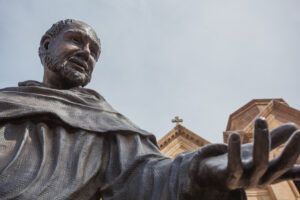
Greccio remains a place of pilgrimage. A hermitage and sanctuary now stand where the original grotto was prepared, featuring frescoes depicting the event. Each Christmas, the townspeople reenact the first living Nativity, continuing a tradition now in its fifth decade.
In December 2019, Pope Francis visited Greccio and signed the apostolic letter Admirabile Signum, reaffirming the importance of Nativity scenes in Catholic devotion. He emphasized that the original scene, enacted with live presence rather than fixed figures, invites believers to “feel and touch” the poverty embraced by Christ at his birth, linking the Incarnation directly to the Eucharist celebrated over the manger.
A Lasting Tradition
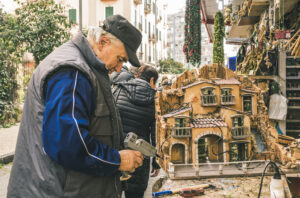
Francis’ living Nativity at Greccio marked a turning point in Christian devotional life. In the centuries that followed, his dramatic reenactment inspired churches across Italy and Europe to create sculpted Nativity displays, first as fixed reliefs or life-size statues set within chapels. By the 1500s, artisans, especially in central Italy and Naples, began crafting smaller, movable figurines for homes, transforming the Greccio living nativity into a personal devotional practice.
By the 18th century, the Neapolitan presepe had become an art form of its own, featuring detailed wooden or terracotta figures arranged in elaborate village scenes. These early Italian traditions laid the foundation for the familiar, inanimate Nativity sets used around the world today. Though no longer “live,” their origins trace directly to Francis’ desire to make the mystery of Christ’s birth tangible and accessible for everyday believers.