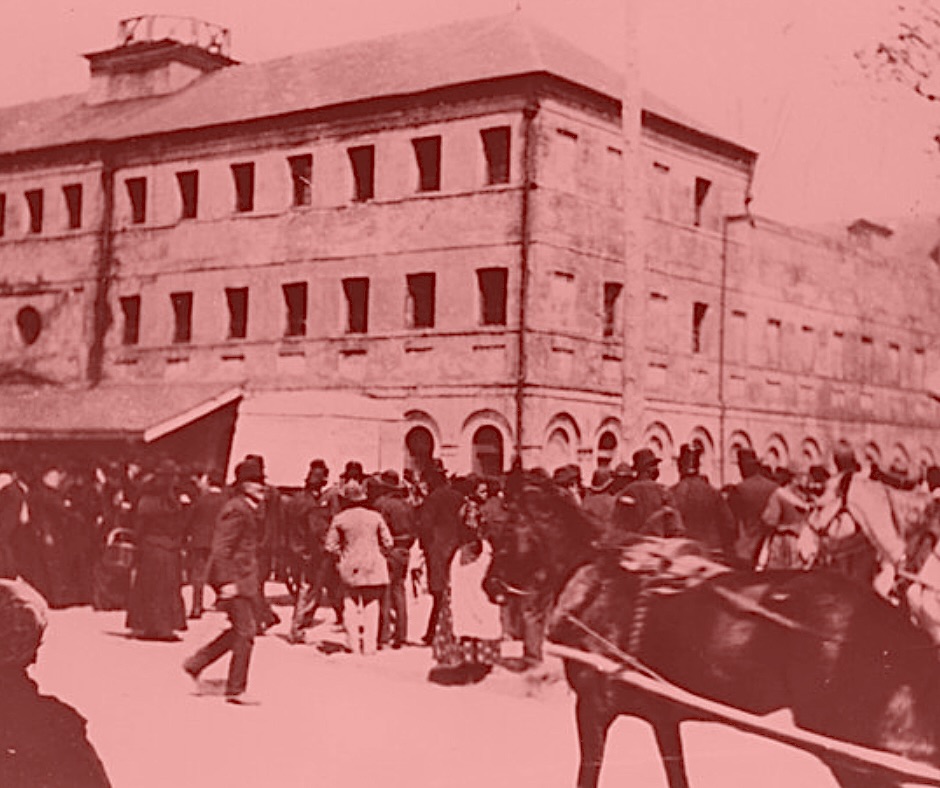
New Orleans’ Parish Prison in 1891 after a mistrial was declared for the 19 Italians arrested in the murder of Police Chief David Hennessy. Citizens gathered at the prison, and speakers would soon incite the crowd (numbering in the thousands) to riot and lynch 11 of the 19 Italian immigrants.
By Mike Santo
For 135 years, millions of Italian Americans lived under a cloud of suspicion over whether a group of Italian immigrants gunned down New Orleans Police Chief David Hennessy outside his Girod Street home before midnight on Oct. 15, 1890. The tragedy played out in a sham investigation, murder indictments of 19 Italian immigrants, and in the courtroom. While not one of the “defendants” was found guilty after a jury trial, a lynch mob numbering in the thousands, assembled by the influential and financially well-heeled establishment members of New Orleans, marched from Canal Street in the business district to Parish Prison, where the defendants were being held.
There, on March 14, 1891, 11 Italian immigrants were removed from the prison and lynched. As if that wasn’t bad enough, there were no repercussions, no arrests, and a bogus grand jury proceeding with no answers. The local and national press, including The New York Times editorial section, applauded the killers for their actions. In effect, mob rule prevailed.
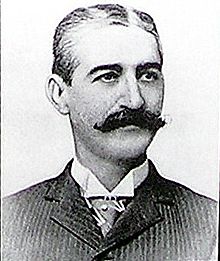
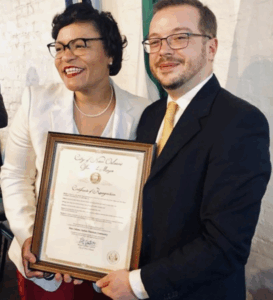
The city’s wounds were unhealed for 128 years until it was addressed by New Orleans Mayor Latoya Cantrell on April 12, 2019. The Mayor publicly recognized that the then “political leadership was complicit in these crimes…during a time of rising anti-Italian sentiment.” Before a crowded room of Italian American leaders, local, state and national press, as well as descendants of the victims, Mayor Cantrell boldly and genuinely offered a proclamation at the American Italian Museum in New Orleans that acknowledged the injustice and expressed her deepest apologies.
The significance of her words becomes even clearer when viewed against the record of Mayor Joseph A. Shakspeare, who governed New Orleans from 1888 to 1892. Aligned with powerful businessmen who controlled the docks along the Mississippi River and profited from the city’s commerce, Shakspeare presided over an era where Italian immigrants were treated as expendable — and even those who managed to succeed were reduced to pawns in a ruthless game of power and money.
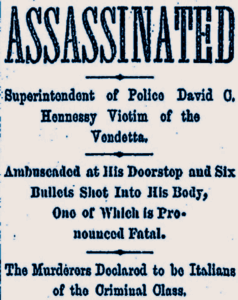
So, there it was: the 11 immigrants, long vilified, were acknowledged as innocent victims. The horrific violence unleashed by a mob of more than 5,000 was finally placed before the public record in 2019, as the press dutifully carried Mayor Cantrell’s words to the world. And then, it stopped there. The city had, at last, offered a measure of closure — an elegant, professional acknowledgment of an ugly chapter in its history. The immigrants were, in effect, exonerated of Chief Hennessy’s murder. Yet one question lingered, unresolved: Who did kill Chief Hennessy — and why?
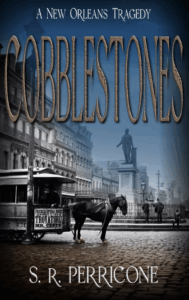
Among those present at the 2019 mayoral apology was Sal Perricone, author of Cobblestones: A New Orleans Tragedy, a new work of historical fiction grounded in this real-life tragedy that scarred the city. A former New Orleans police officer, later an FBI agent and federal prosecutor, Perricone was determined to uncover the truth. His path crossed with Salvatore A. Serio, a U.S. Marine veteran and volunteer curator at the Italian American Resources Center in Metairie, Louisiana. The Center had received a donation of archival boxes from local advocate Joseph Maselli, and Serio encouraged Perricone — already the author of two books — to dig into them. Inside, Perricone discovered rare and difficult source material that challenged him but also fueled his drive to treat the affair as a long-neglected “cold case.” From those boxes came the research and revelations that inspired him to write the novel.
The local press reported that Chief Hennessy’s final words, spoken to a close friend, were that “the dagos” had shot him. This sparked the phrase, “Who killa da Chief,” which remained a way of instigating and insulting any Italian at the time. In fact, today’s anti-Italian American mafia tropes can be traced back to Hennessy’s assassination and the lynching that followed. As a young teenager growing up in New Orleans and attending a school only a few blocks from Parish Prison (now Louis Armstrong Park), this remained vivid and heavy in Perricone’s mind.
In Cobblestones, Perricone introduces a fictional character, Antonio Carravella, and his journey — more of an “escape” — from Bisacquino, Sicily (the author’s grandfather’s hometown) to New Orleans. The author presents the harsh realities of the time period for Sicily: a very poor region with hard working people in search of jobs and opportunity. There are references to the Padrone System at work, where “godfathers” exploited the locals to earn commissions from the steamship lines. His character is painted as one of the more fortunate ones, who is taken under the wing of a Jesuit priest with church connections in Europe and America. The Jesuits help Antonio make his way by ship to America, where he would learn that many of the problems from which he believed to have left were present in a similar form in New Orleans.
Perricone’s descriptions of the late 1800s-period is captivating and informative, detailing the modes of travel, the economy and businesses of the southern United States region, and the devilish dominance of those of power in a major city. He provides intricate details of history in palpable doses from the evolving perspective of Antonio, who is now working as a runner for a local newspaper covering the trials of the time. The author’s deep dive into the legal proceedings leading up to and including the lynching trial is exquisite and very telling of the legal system. He exposes the marionette-like control of the police and the government by the businessmen of the time.
The author’s impressive research includes quotes from legal proceedings, press coverage, correspondence, and other material not printed anywhere else to date. His work, in short, is the penultimate writing on the subject of not only the Italian tragedy, but one which defines and articulates how events of the March 14, 1891, lynching exploded from a local territorial issue to an international affair involving the Italian government and then-U.S. President Benjamin Harrison.
Perricone provides accounts of the meetings before and after the lynchings. He builds the “case” for his hypothesis in a detailed manner as a criminal prosecutor would for a trial. His background and experience pour onto the pages in a systematic and reasoned approach. It becomes clear: the “dagos” did not kill Hennessy; the vitriol and hate mongering of the press subjected Italian immigrants to a long and needless social stream of stereotypes. The motivation in writing the book was to expose the truth; the result was vindication.
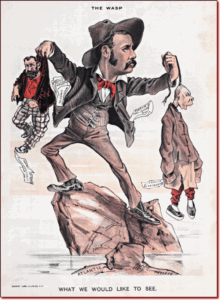
In 1892, the diplomatic pressure from the lynching produced results. There were reparations paid to the victims’ families. President Harrison issued a proclamation celebrating the 400th anniversary of Columbus’s discovery of the New World. Harrison was forced to intervene in the New Orleans lynching. He had no choice.
In Columbus, Italian Americans now had their symbol to help assimilate and move upward in our nation. The book proves that Italians were victims, yet society hardly considers them as such and certainly not now after years of bias in the press, nor how the media and Hollywood slanders and portrays Italians in a negative light. Mr. Perricone’s timely book is a shocking reminder of why the lessons of history must be published. We have him to thank for his thorough research and presentation.
Other immigrant groups came to America. There were many other instances of shame, tragedy, and horror in our history. Through Cobblestones, the reader learns of just one, but one that never was addressed at the level to which it is now.
To purchase Cobblestones on Amazon, click here.
Mr. Santo has been an active advocate of Italian American affairs for more than 40 years, acting as counsel to a variety of well-established Italian American organizations. He spearheaded the request for the New Orleans mayoral apology in 2019. He continues to practice as a civil litigator on behalf of injured clients as well as offers his pro bono services to Italian American projects.
Contact: AttySANTO@gmail.com