
By Carmen Amato
Joseph “Joe” Sestito was a deputy sheriff of Oneida County, New York in the late 1920’s. He was a hard, no-nonsense man with a tough job.
Thanks to Prohibition, by the time Joe wore the uniform, one deputy sheriff had already been killed chasing bootleggers in 1921.
Years later, Joe’s children and grandchildren would crowd into the Sestito kitchen after Sunday Mass. As his wife poured coffee and thimble-sized glasses of anisette, Joe could be persuaded to talk about his days as deputy sheriff. His audience was always on the edge of their seats, listening to tales that would eventually inspire the award-winning Galliano Club books.
I know, because Joe was my grandfather.
Early years
Joe was the oldest of the seven children of Nicola and Marietta Sestito, both from Serra San Bruno, Calabria, who settled in Rome, New York. After three years of school and a stint as a barber’s apprentice, he lied about his age to get a job at the Revere Copper and Brass Rolling Mill. At the time, Revere was Rome’s biggest industry and employer, a few blocks from the Italian neighborhood called East Rome.
He joined the Liberty Club, a social hangout for Italian men and developed a reputation as a hellraiser. One time, he and friends fell through the frozen Mohawk River while skating. They built a fire, stripped off their clothes and dried them. There was little choice; they’d die of exposure in wet clothes.
Which escapade brought Joe to the attention of Oneida County Sheriff John G. Thomas has never been clear, but he personally appointed Joe as one of several deputy sheriffs at a time when more muscle—and an Italian speaker—was needed.
Midway between the Canadian border and New York City, Oneida County was a crossroads for bootleggers and smugglers. Meanwhile, local residents hid stills in farm buildings like the trio from East Rome who operated a “complete distillery . . with two 1,000-gallon tanks” in a farmhouse. According to the Rome Daily Sentinel, Boniface Mariana, Martial Del Nero and Carmino Tuosto were arrested when federal agents traced their equipment purchases.
Jailer Joe
Joe’s primary job as deputy sheriff was to supervise the county jail in Rome. One day as prisoners lined up, one of them kicked Joe with a steel-toed boot hard enough to break a leg.
Joe punched the prisoner into submission but the damage was already done.
The broken leg swelled. By the time Joe clocked out and limped home, the front of his leg was a lurid bloom of black and blue, with a 2-inch dent in the shinbone midway between ankle and knee that would remain with him forever.
Another time, Joe had to transport a prisoner and borrowed his brother’s new Oldsmobile roadster to do so. Unhappy at the fate awaiting him, the prisoner threw himself at Joe who lost control. The roadster careened off the road and flipped into a pond.
The deputy and his prisoner survived. The vehicle was less lucky.
Joe was also tossed into the melee of Prohibition enforcement. One night, he was assigned to stake out the city cemetery.
A gang of bootleggers had staged an elaborate funeral. Rumor had it that instead of a corpse, the casket was loaded with a fortune in illegal booze bound for New York City. The bootleggers were bound to come back to the cemetery to retrieve it.
Unwilling to go to the cemetery alone, Joe enlisted the help of his best friend, Hank Rizzuto.
Hank, the father of future Givenchy fashion house scion John Rizzuto, sold insurance.
In the cemetery, the two men huddled behind a large headstone where they could see anyone who approached the fresh grave.
Joe’s hand twitched on his revolver. He didn’t know how many bootleggers would turn up.
It was a cold autumn night, but the ground had yet to freeze. The sky was pitch-black, the rustling wind sounded like a legion of ghosts while the tilting headstones spoke a haunting silence.
They waited . . .
Ten, possibly 15 minutes.
Joe and Hank scrambled to their feet and made a run for it. If the bootleggers had the guts to come back and dig up a liquor-filled casket, they were welcome to it.
The deputy takes a wife
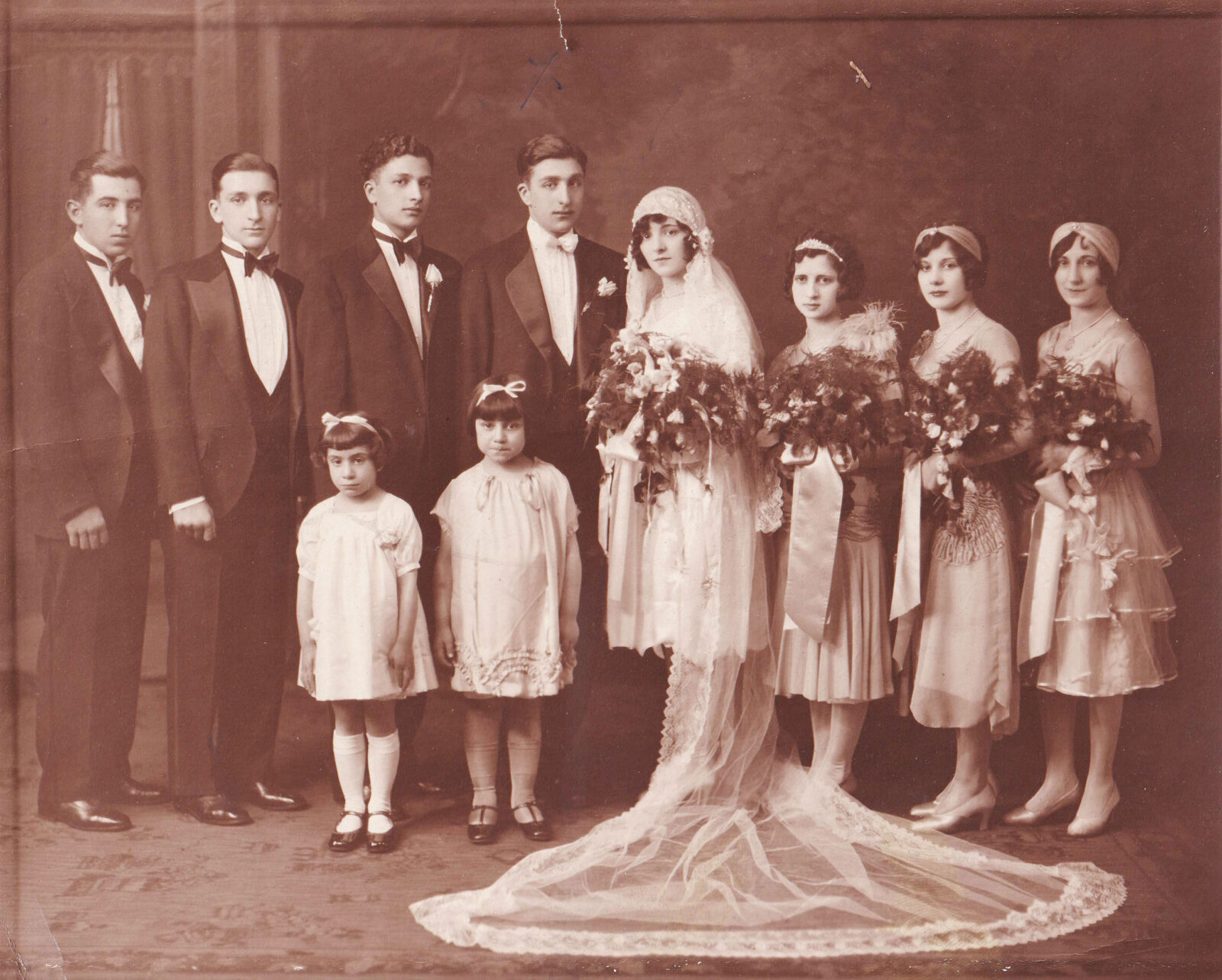
In April 1928, Joe married Marianne “Ann” Amateau, whose family had also emigrated from Calabria. They wed in Newark, New Jersey, then traveled by train to Rome for a reception.
That night when he should have been with his new wife, Joe was called to duty at the courthouse. A double murder had occurred. The perpetrator was at large.
Not only did Joe know killer Vito Stagliano and the two victims, but all three had attended the wedding reception just hours before.
In its breathless account of the murders and manhunt that followed, the Rome Daily Sentinel didn’t name Joe and Ann Sestito as the happy couple, nor Joe’s role as a deputy sheriff, only saying that “All three men and some of the children returned Sunday afternoon from a wedding reception at Unity Hall. A countryman had been married in New Jersey and his friends here were guests at a feast.”
Stagliano was found the next day “almost uncontrollable with fear” that he would be killed by the family and friends of his victims.
It was an uneasy start to marriage for Joe and Ann.
The murderous father-in-law
Years later, I wondered if my grandfather knew that his father-in-law was also a double murderer.
Sixteen years before Joe and Ann married, her father killed both his wife and a neighbor in Hartford, Connecticut.
Guiseppe and Carmella Amato and their five children lived on Spruce Street, in a tenement housing Italian immigrants. Neighbor Giovanni Tassone was considered a violent and unstable man. His wife ran away on at least one occasion, only to be found by a private investigator, according to the Hartford Courant.
In July 1912, Guiseppe secretly sold his barber shop and bought an automatic handgun, giving a false name and address to the store owner. He also drained his bank account and destroyed a drawing of himself which had occupied pride of place in the family apartment.
On the evening of July 23 Guiseppe shot and killed Tassone in the Amato apartment.
Both wives tried to intervene. Guiseppe shot them as well. He fled toward railroad tracks and disappeared into a maze of rail cars.
Tassone died immediately. Carmella died three days later.
Despite a vigorous manhunt and widespread media coverage, Guiseppe Amato was never seen again.
The Amato children, all of whom were thought to be in the apartment during the shootings, were parceled out to relatives and never saw each other again. Ann grew up in the home of Ciro Amato, her mother’s brother. She attended school through sixth grade, then became a tailor in New York City’s garment district.
Our family didn’t find out the real story until after Ann had passed. She always claimed that she and her siblings were orphaned when her parents returned to Italy and died in a train accident. But if Ann believed that story, why did she change the spelling of her last name to Amateau and claim that her father was French?
If Joe knew the truth, he never said.
After Prohibition
One of my earliest memories is of going to the new police station in Rome with my grandfather.
To the hilarity of the cops at the station, he locked his toddler granddaughter in a cell and caught up with his cronies.
Joe was City Marshal then, back in law enforcement circles after many years. His appointment as deputy sheriff didn’t survive the Great Depression, which settled over upstate New York like a solid, smothering blanket. The mills closed. Joe worked as a barber and even sold chickens from the back of his truck to support his family.
Eventually the Revere mill reopened. Joe rose to the position of shift foreman during World War II and de facto deputy to mill foreman Art Tedd, a lifelong friend who would become mayor of Rome. “It was hard work but not really too dangerous,” Joe recounted in an interview in 2001 with the Rome Daily Sentinel to mark Revere’s 200th anniversary. “I was in charge of three bays with three cranes in each. That’s nine cranes I had to watch.” Joe also developed a test for a critical chemical solution. “I would dip my finger into the solution and rub it across my tongue. I could always tell, always, whether it needed more or less acid.”
After retiring from Revere, Joe became a constable and City Marshal, serving legal documents like summonses and divorce papers. He collected debts and enforced the seizure—garnishments—of wages to pay off creditors.
I still have his ledgers from the 1950’s and 60’s. Among other things, they are a record of the debts, lawsuits, and feuds of the Italian community in Rome. Familiar names jump off every other page: Cicero, Squadrito, Cianfrano, Esposito, Giardino.
He earned a percentage of debts collected and $2.50 for each summons delivered into the right hands. For example, on August 19, 1958, he earned $2.50 for serving a summons to John Naroli, in dispute with Louis Pettinelli, resident of 516 West Dominick Street. When Vito Doria finally paid his bill of $69.40 in full to Breman’s Brake Service, Joe earned $8.90.
Once again it was a dangerous job, taking Joe into neighborhoods where money was tight and tempers were hot.
He carried the same revolver as when he was a deputy sheriff.
From Sunday stories to award-winning books
Joe survived Ann by 16 years, passing in 2004 in his 100th year. Over the years, he seemed unchangeable, always hard as iron. His only weakness was industrial deafness, legacy of his years with Revere.
He missed the pandemic that caused lockdowns across New York state, including the senior living community where my mother Jean—Joe and Ann’s oldest—lived. To alleviate her sense of isolation, I called every night.
I shared my idea for books based on her father’s stories set in East Rome. She was my biggest fan and the Galliano Club series became a collective effort, bridging the distance enforced by the pandemic. My mother offered more stories, more memories.
The 4-book saga is set in 1926 during the height of Prohibition. An immigrant from Calabria desperately holds on to the Galliano Club as a gunslinging Chicago bootlegger tries to turn it into a speakeasy.
With its double decker houses and warren of narrow streets where Vito Stagliano killed my grandparents’ wedding guests, Joe’s East Rome became East Lido. Dominick Street—the boulevard synonymous with Rome’s Italian neighborhood–is recast as Hamilton Street.
Besides Joe’s cameo appearance, his cemetery stakeout is in the books, along with the copper mill, family feuds, bootleg beer and so much more.
The first novel in the series, Murder at the Galliano Club won the Silver Falchion for Best Historical in 2023. The last in the series, Revenge at the Galliano Club was a finalist for the same award in 2024. Find the books here: https://carmenamato.net/galliano-club-series
What would Joe think about his experiences being turned into award-winning historical fiction thrillers?
It’s hard to know. After all, writing is “not really too dangerous.”
Make a Pledge and join Italian Sons and Daughters of America today.
ABOUT THE AUTHOR: Inspired by the real-life exploits of her grandfather Joseph Sestito, who was a deputy sheriff in upstate New York during Prohibition, mystery author Carmen Amato created the Galliano Club historical fiction series. Set in 1926, the first novel in the series, Murder at the Galliano Club, won the 2023 Silver Falchion Award for Best Historical. Third in the series, Revenge at the Galliano Club, was nominated for the same award in 2024.
A 30-year veteran of the Central Intelligence Agency, Carmen Amato also writes the contemporary Detective Emilia Cruz series pitting the first female police detective in Acapulco against Mexico’s cartels, corruption, and social inequality. Optioned for television, it’s a 2-time winner of the Outstanding Series award from CrimeMasters of America and was lauded by National Public Radio as “A thrilling series.”
Her standalone thrillers include The Hidden Light of Mexico City, which was longlisted for the 2020 Millennium Book Award.
Carmen is a recipient of both the National Intelligence Award and the Career Intelligence Medal. She has been a judge for the BookLife Prize and Killer Nashville’s Claymore Award. Her work has appeared in Huffpost, Criminal Element, Publishers Weekly, and other national publications.
Originally from upstate New York, after years of globe-trotting she and her husband enjoy life in Tennessee. https://carmenamato.net/links
