
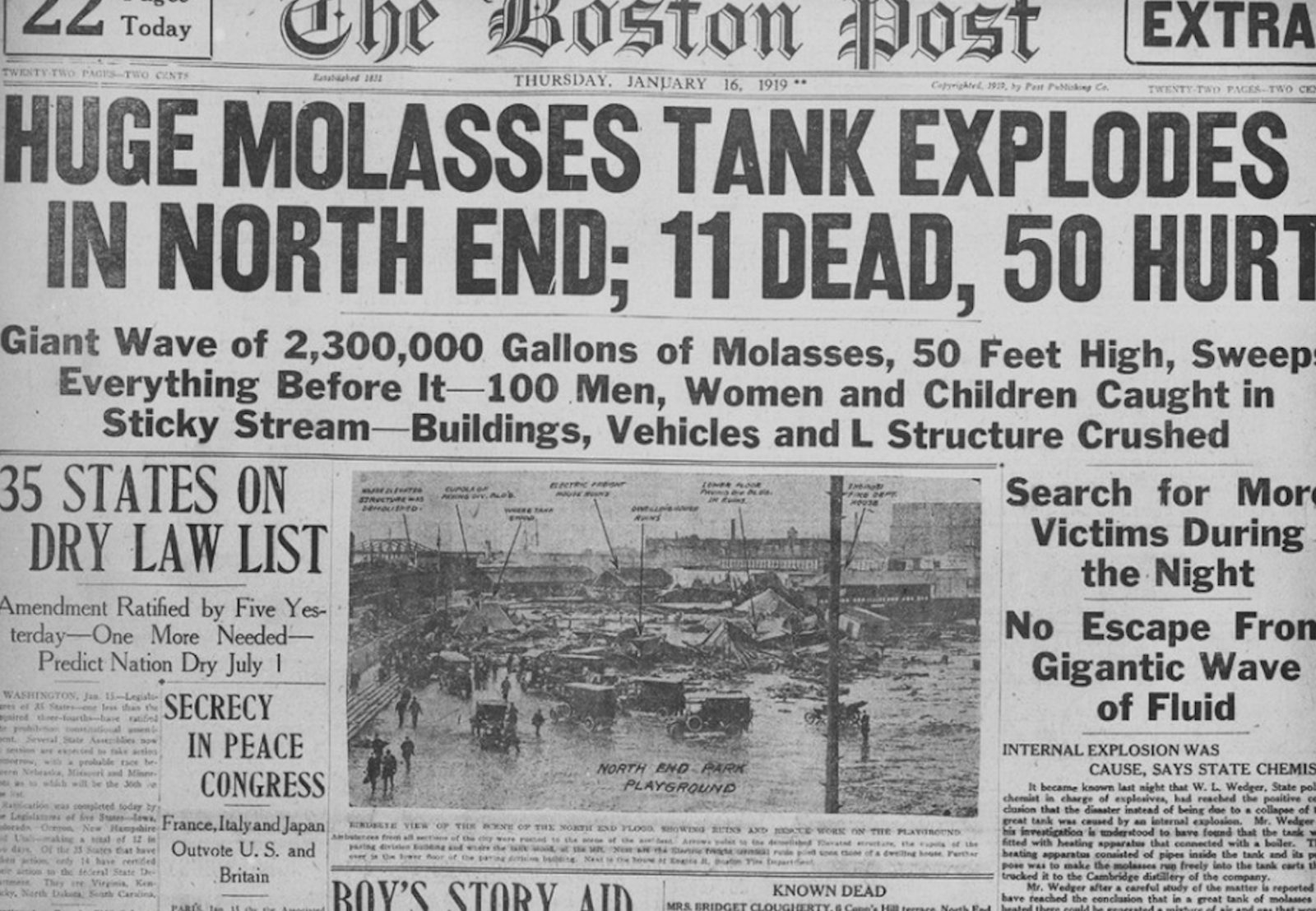
On January 15, 1919, Boston’s North End — a neighborhood rich in Italian American heritage — was the site of a catastrophe that would become infamous in history: the Great Molasses Flood. A massive steel tank containing 2.3 million gallons of molasses burst, sending a 25-foot wave of the sticky substance through the streets at speeds up to 35 miles per hour. This devastating deluge killed 21 people, injured 150 others, and caused immeasurable damage to the densely populated working-class community.
The North End had long been a haven for immigrants, particularly Italians, who had built a vibrant enclave despite facing significant economic and social challenges. Many residents lived in overcrowded tenements near the waterfront, where the tank stood. Owned by the United States Industrial Alcohol Company, the structure had been hastily built during World War I to supply molasses for the production of industrial alcohol, a key ingredient in munitions.
The disaster occurred at around 12:30 p.m. on an unseasonably warm day. As the tank failed, the molasses wave obliterated everything in its path — buildings, freight cars, and even sections of elevated train tracks. Among the victims were several Italian Americans, many of whom worked nearby as laborers or dockhands. Entire families were displaced, and livelihoods were destroyed, further compounding the struggles of an already marginalized community.
In 1983, Smithsonian Magazine wrote of one child’s harrowing experience:
“Anthony di Stasio, walking homeward with his sisters from the Michelangelo School, was picked up by the wave and carried, tumbling on its crest, almost as though he were surfing. Then he grounded and the molasses rolled him like a pebble as the wave diminished. He heard his mother call his name and couldn’t answer, his throat was so clogged with the smothering goo. He passed out, then opened his eyes to find three of his four sisters staring at him.”
In the aftermath, the molasses flood became a symbol of corporate negligence. Investigations revealed that the tank had been poorly constructed; its walls leaked so badly that children often scooped molasses off the ground. The owners had ignored warnings about the tank’s structural integrity, prioritizing profit over safety.
The disaster also sparked one of the first major class-action lawsuits in U.S. history. Survivors and the families of victims — many of them Italian Americans — organized to demand justice. After six years of litigation, the United States Industrial Alcohol Company was found liable, resulting in settlements that provided some relief to the affected families.
For Boston’s Italian American residents, the Great Molasses Flood was both a personal and collective disaster. It highlighted the vulnerabilities of immigrant communities, who often bore the brunt of industrial recklessness. Today, the unusual disaster is remembered as a cautionary tale about the human cost of corporate negligence and the struggles and resilience of Boston’s Italian Americans.
Make a Pledge and join Italian Sons and Daughters of America today.
