
By Brendan Young, La Nostra Voce
Commonly called “the Grunt Padre,” his name is Fr. Vincent Capodanno. Vincent Capodanno, Jr. was born in Elm Park, Staten Island, New York, in February 1929, the youngest of 10 children born to immigrant parents from Gaeta, Italy.
A first-generation Italian American, young Vincent was immersed in our typical ethnic experience, imbibing its values: the primary place of family, embracing hard work and sacrifice as a means of betterment of self and family, the significance of education and the opportunities it offered, the vital support of fraternal solidarity, and of course, the indispensable Catholic faith. These ideals would keep the family going throughout the Great Depression, and the loss of Vincent Sr. on his namesake’s 10th birthday. Three of Vincent’s brothers would serve in the Armed Forces during World War II, undoubtedly contributing to their little brother’s sense of patriotism and duty.
This article first appeared in the June 2024 edition of ISDA’s monthly Italian American newspaper, La Nostra Voce. Subscribe here
He was a talented swimmer and enthusiastic athlete. Following high school, Vincent worked on Wall Street while enrolled as an undergraduate at Fordham University. But his heart urged him to take another path in life, and following a spiritual retreat in 1949, he answered the call to become a missionary. Like thousands of subscribers in those years, and in later decades, Vincent learned about the exciting missionary efforts of the Maryknolls (formally called the Catholic Foreign Mission Society) thanks to their magazine, then called The Field Afar.
Vincent was accepted to enter the Maryknoll Seminary, and after nine years of study, was ordained a priest in June 1958. The following year, Fr. Capodanno was sent to Taiwan, where he quickly learned Hakka Chinese and served the local people, endearing himself to them and proving himself a real father and friend. After several years, he would go on to serve in Hong Kong.
But it was in August 1965 that Fr. Capodanno received permission to respond to what might be described as a call within a call, this time to serve his country as a military chaplain. He was commissioned as a Lieutenant in the Navy in December, and would train at Newport and Camp Pendleton. Completing Officer Candidate School, he volunteered for immediate duty, and was sent to Vietnam in April 1966. There he served with the Fleet Marine Force, as a chaplain for the Marines, who, not having their own chaplains, used those of the Navy.
Fr. Capodanno’s first tour was spent until April 1967 in the service of the 1st Battalion, 7th Marines, an infantry battalion of the 7th Marine Regiment, and later the 1st Medical Battalion. His first concern was the young, enlisted men, called the “grunts.” As their chaplain, he did not have to but selflessly made their challenging and humble living conditions his own, eating what they did, sleeping as they did. He accompanied them everywhere, not shying away from the fire of the battlefield.
He would also assist the local villagers, distributing necessities and gifts as he was able, establishing outreach programs when possible, even starting libraries. He was a true spiritual father, reassuring, comforting, offering guidance and support, and of course, celebrating the sacraments. In June 1967, his service was extended, and Father’s second tour began with the 5th Marines, his return to the United States set for October.
It was during this second tour, on September 4, 1967 (Labor Day), while with the 3rd Battalion of the 5th Marines that this Italian American priest heroically made the ultimate sacrifice. During hours of heavy fire after a North Vietnamese ambush, Fr. Capodanno himself sustained serious injury, disregarding the automatic weapons, and mortar fire, he traversed the battlefield to administer Last Rites, and provide medical aid as much as he could. When an exploding mortar caused numerous wounds to his arms and legs, and severed part of his right hand, the Padre refused assistance beyond basic patching up. Rather, he directed the other soldiers to aid their wounded brothers and kept crossing the field to encourage and assist the others.
Approximately 15 yards away, Fr. Capodanno spotted and set out to assist a wounded marine, to spiritually minister and administer medical aid to him. In doing so, the Grunt Padre fell victim to 27 bullet wounds, inflicted by an enemy machine gun, despite being unarmed himself. His body was recovered and returned home to America. Following a funeral mass in North Arlington, New Jersey, on September 19, his remains were interred in the family plot at St. Peter’s Cemetery in Staten Island.
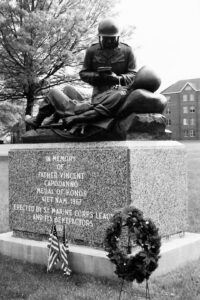
Posthumously, Fr. Capodanno was honored with the Medal of Honor in 1969, as well as the Navy Bronze Star medal, the Vietnamese Cross of Gallantry with Silver Star and the Purple Heart Medal. Several military chapels, in Vietnam, Japan, Taiwan, and the United States, were named for him. Other memorials are found throughout the United States and Italy. But perhaps most prestigious of all, was the naming of the USS Capodanno, which, under the motto of “Duty with Honor,” was one of the few American vessels to receive a papal blessing, during its two decades of service.
In 2006, Fr. Capodanno’s cause for beatification and canonization into sainthood was introduced by the Archdiocese for the Military Services. In 2013, the creation of the “Father Vincent Capodanno Guild” was announced during the annual memorial mass for the priest celebrated in Washington, D.C. The Guild is the main organization dedicated to promoting the memory and devotion of “the Grunt Padre,” throughout the country and the world.
We are justifiably proud to be Italian American; we are proud because of the accomplishments of our forebearers, and even our own. Our unique identity combines the best of our rich heritage from the Old World as well as this nation in which we have been born or have arrived. The story of Fr. Vincent Capodanno, the “Grunt Padre,” should fill us with even more pride. Fr. Capodanno’s, is truly one of the most heroic and shining examples of Italian America. His heroism, his generosity and his holiness should not only inspire us in our own journeys, but should be shared with our families and friends, and held up as a paradigm of our people.
For more information, see: www.capodannoguild.org
Brendan Young a second-generation Italian American from Buffalo, New York, is a member of ISDA.
