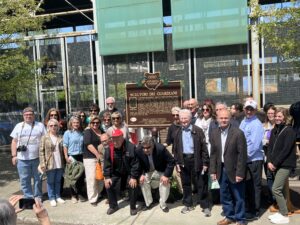

In May, Random Road was closed down in Cleveland’s Little Italy neighborhood for the unveiling of a historical marker that pays tribute to the Italian immigrant stonemasons who carved some of the city’s most iconic stone works.
The marker was placed at the site of the former Ohio Cut Stone Co., where Cleveland’s “Guardians of Traffic” were hand-carved piece by piece and then hauled to the century-old Hope Memorial Bridge, which was built to connect the city’s East and West sides.

The marker was funded by The Ohio Historical Markers Program, the William G. Pomeroy Foundation, and the Unione E Fratellanza Oratinese.
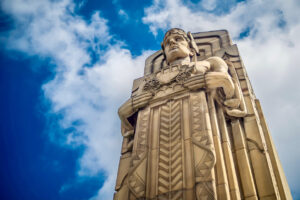
The Cleveland Guardians MLB team take their name from the towering statues, and several ancestors of these elite sculptors still live in Northeast Ohio today.
“The marker is a testament to this lost art of freehand stone carving, which dates back to ancient Rome,” said Pamela Dorazio Dean, director of the Italian American Museum of Cleveland (IAMCLE). “Generations of fathers and sons passed down these skills through the millennia, all the way to these immigrants from Oratino, Italy, who were known as scalpellini.”
The immigrants who gave rise to the Guardians
Discussions to construct a bridge that would prominently connect Cleveland’s East and West sides began as early as 1911, when Cleveland was a rapidly growing city In fact, at that time, Cleveland was the sixth largest city in the nation with a population of more than 560,000 people, many of whom were immigrants.
One group of Italian immigrants, however, possessed specialized skills in working with stone and were brought to Cleveland for that reason. These men were called scalpellini.
Giuseppe Carabelli (1850-1911) is credited for bringing many scalpellini to Cleveland to work for him, and several local stone-cutting firms took notice, with many going to great lengths to recruit them. Ohio Cut Stone was based several miles west of Cleveland, so they intentionally opened a warehouse in Little Italy where the Guardians would eventually be carved and completed in 1932.
The four, two-sided Guardian statues are 43 feet tall, and at the time, they cost $8 million to make (that’s $138 million in today’s money, when adjusted for inflation).