
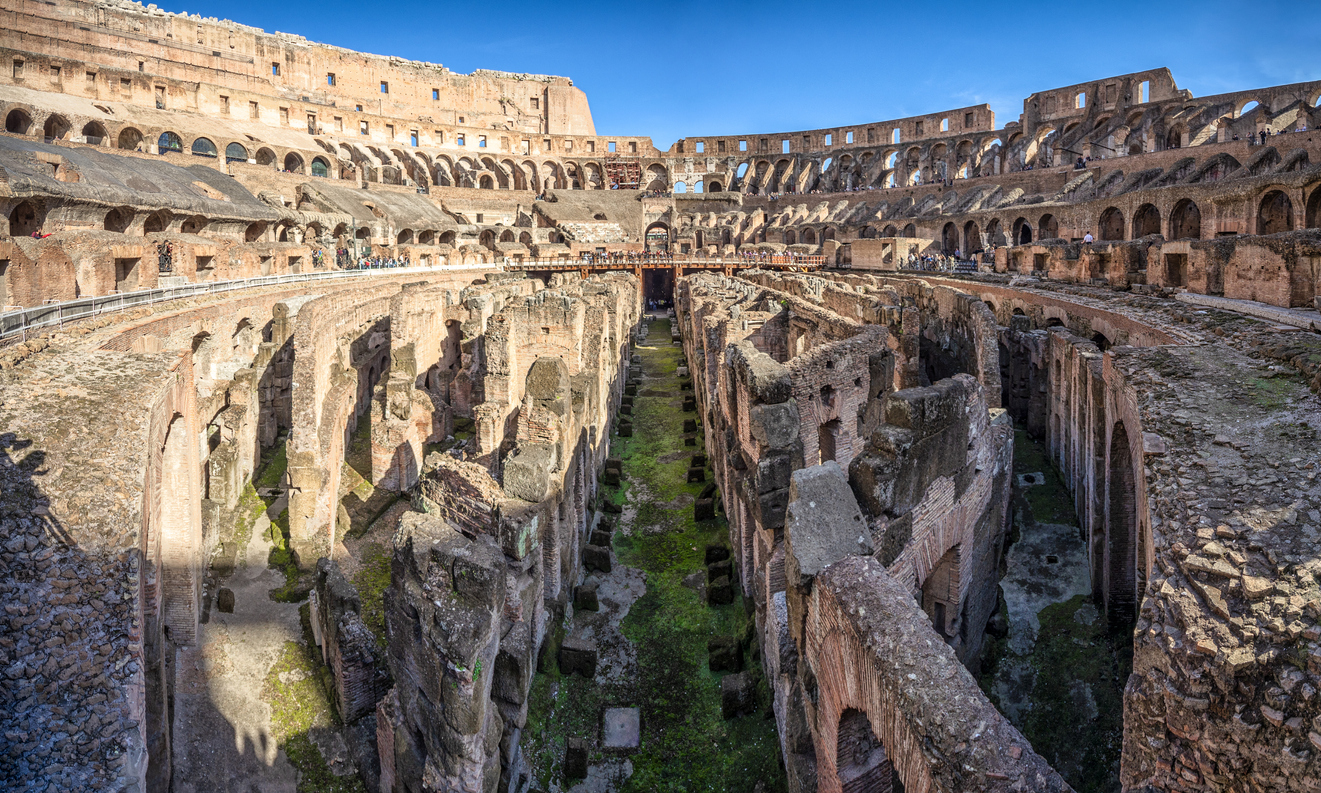
Thousands of people in ancient Rome watched enslaved men, convicted criminals and untamed animals battle in the city’s mammoth Colosseum.
To make these gruesome displays possible, Roman architects and engineers designed an elaborate set of tunnels below the arena’s wooden floor, Smithsonian Magazine reports.
Once the Roman Empire collapsed in 476 A.D., almost two-thirds of the Colosseum—including the network of subterranean chambers, also known as the hypogeum—fell into a state of disrepair. But in 2018 experts began renovating the hidden system of passageways, so tourists would be able to roam where gladiators and wild animals once prepared for combat.
As Angela Giuffrida reports for the Guardian, officials unveiled the newly renovated hypogeum in a ceremony in late June.
Now, the public can walk through 525 feet of wooden walkways for the first time in the Colosseum’s 2,000-year-old history. This unveiling follows the two-year, $29.8 million restoration project, which was initially funded by the Italian fashion company Tod’s, writes Artnet News.
Yesterday, I explored the underground tunnels and chambers of the Colosseum where gladiators and wild animals once prepared for combat. The Colosseum’s underground tunnels are now fully opened to the public by purchasing the Full Experience ticket. @ParcoColosseo pic.twitter.com/uqM1yMRQoS
— Following Hadrian (@carolemadge) June 30, 2021
“Today we are returning to the public a monument within a monument,” says Alfonsina Russo, director of the Colosseum and its archaeological park, as quoted by the Guardian. “What emerged [from the project] is that the hypogeum had a 400-year-long history, from when the amphitheater opened in AD80 to the final show in 523.”
A new floor coming soon
Also, by 2023, tourists and local visitors will be able to stand on the Colosseum’s floor, which will sit atop the newly accessible labyrinth of tunnels and corridors.
According to The New York Times, the new floor will feature a lattice of specially treated wooden slats that can be rotated to allow air to circulate and to expose the beehive of subterranean corridors. It was created by a team led by Milan Ingegneria.
The arena is the most visited site in Italy, and prior to the pandemic, it attracted nearly 8 million tourists a year.
Historians estimate that 400,000 people perished in front of a mob of roaring fans, and it remains the largest standing amphitheater in the world today
Make a pledge and become a member of Italian Sons and Daughters of America today!
